

Zebralight SC51 (XP-G R4) & SC50w (XP-E Neutral) 1xAA Reviews: RUNTIMES, BEAMSHOTS +
Warning: Pic heavy, as usual.
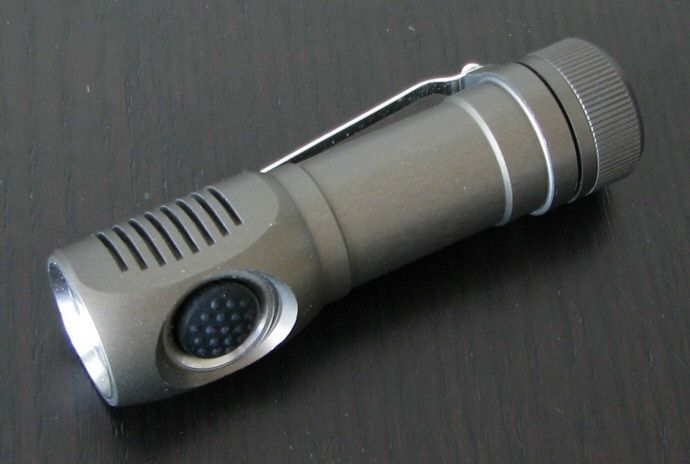
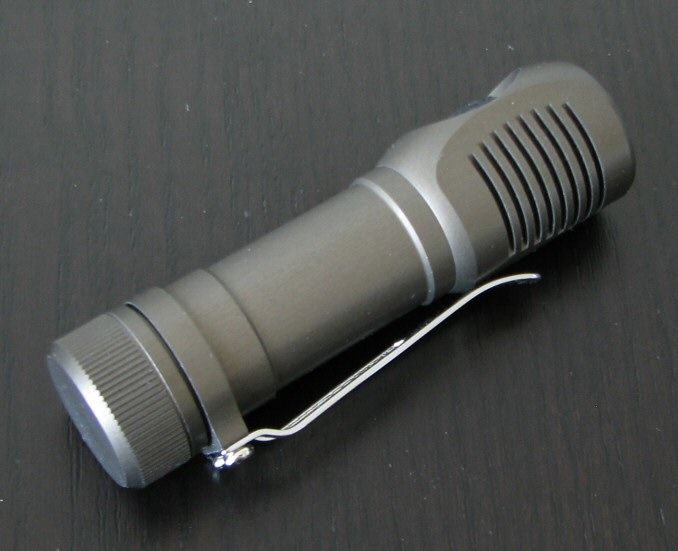
Zebralight has gone through a couple of iterations of the 1xAA forward-projecting SC50 model flashlight – although most of these have been relatively minor circuit tweaks.
For this review, I have on hand a late model neutral-white XP-E emitter SC50w from just before the introduction of the SC50w+ version. Not much has changed - the "+" version has a new secondary Hi mode on 14500 instead of strobe (107 Lumen), and slightly brighter primary Med mode (36 instead of 33 Lumens) on both standard AA and 14500. But otherwise, the build is identical.
I also have a soon-to-be-released new SC51 cool-white sample. The SC51 uses the newer XP-G emitter (R4 output bin), but is otherwise identical in build to the SC50 line. The circuit seems similar to the SC50w, although strobe is no longer present at all (i.e. the secondary Hi mode is available on both standard AA and 14500).
SC50w+ Specifications (taken from Zebralight):
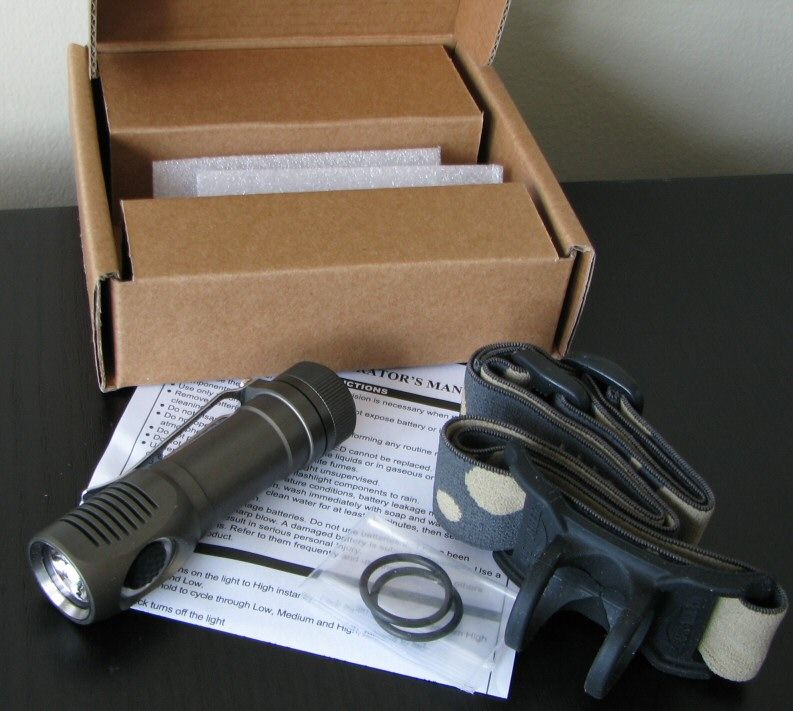
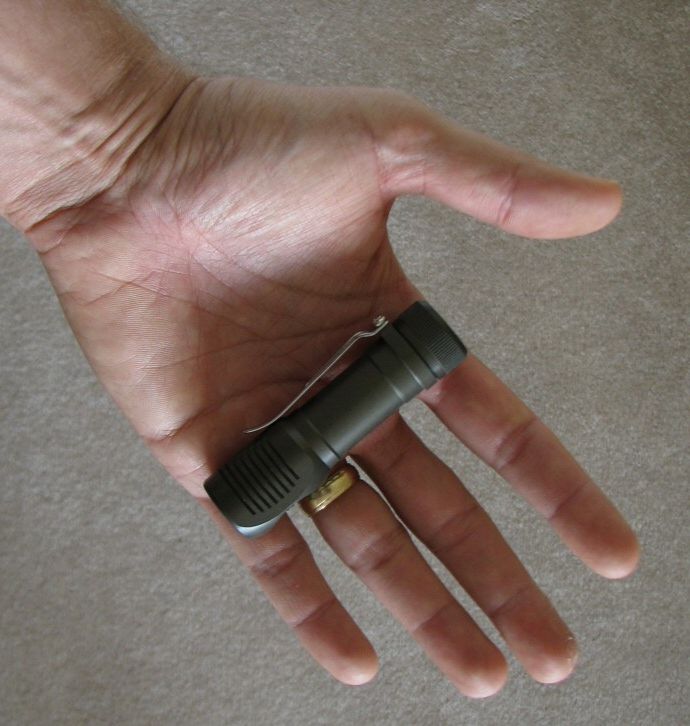
For both lights, included in the simple but firm cardboard box was the light with removable clip (attached), extra o-rings, and a one-page instruction sheet. The SC50w also came with the classic Zebralight headband with soft plastic light holder (shown above) – but the SC51 sample was lacking this accessory.
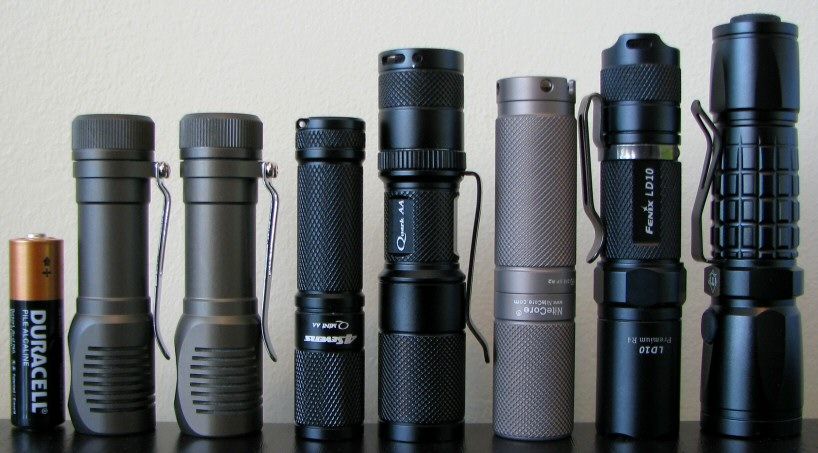
From left to right: Duracell alkaline, Zebralight SC51, SC50w, 4Sevens Quark Mini AA, Quark AA, NiteCore D10-SP, Fenix LD10-R4, ITP SA1
SC50w: Weight: 37.8g (no battery), Width (bezel) 22.4mm, (tailcap) 21.4mm, Length 80.5mm
SC51: Weight: 37.4g (no battery), Width (bezel) 22.4mm, (tailcap) 21.4mm, Length 80.5mm
As you can see, the SC50/51 series is quite tiny.
The overall dimensions of the SC51 are exactly the same as the earlier SC50/SC50+ series – it's only the emitter that appears different (XP-G on the SC51 instead of XP-E on the earlier models). SC50w first, followed by SC51:
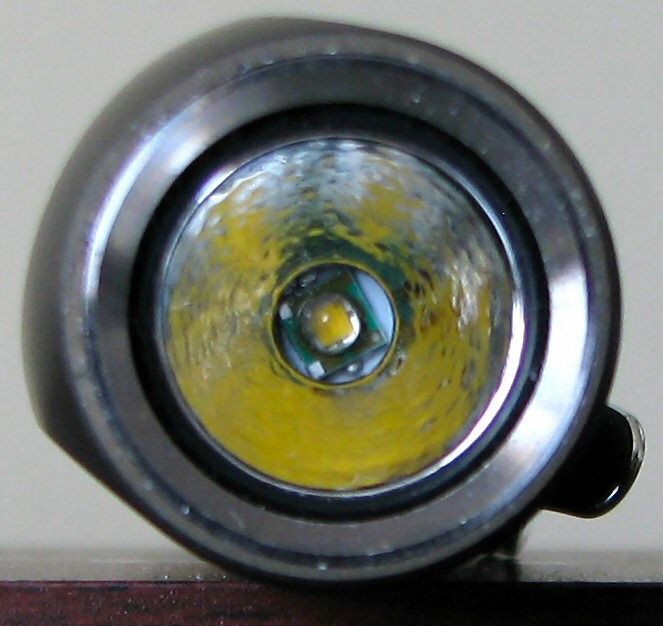
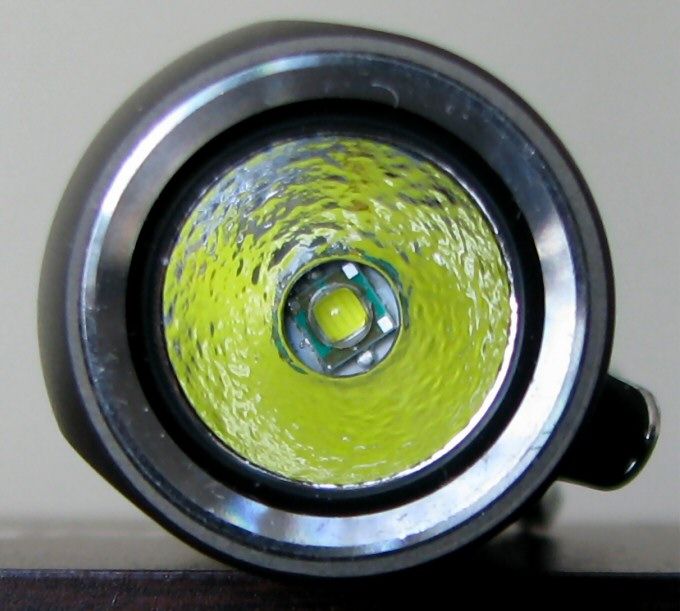
The SC51 sample I have uses a XP-G emitter with R4 output bin. The SC50w doesn't specify an output bin for the XP-E emitter, but I understand from Zebralight that the Neutral white version currently comes from a 5B4 tint bin.
Reflectors look identical, and are medium textured (medium orange peel), and a reasonable depth for this size light.
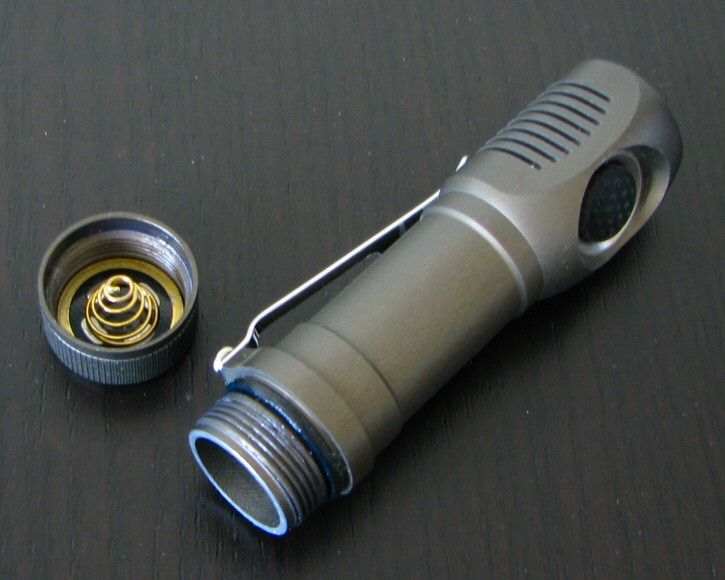

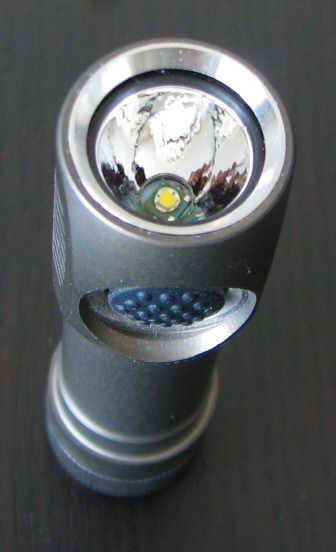
The lights have flat-bottomed tailcaps and electronic control switches on their heads. The switches are covered with textured boot covers, and are easy to access. Feel of the switches are good for this type, with a lightly audible click as you make contact. Note that electronic switches are not like traditional mechanical clickies – think more like the buttons on your DVD player, flat-screen monitor, etc.
Tailcap threads are anodized, allowing for tailcap lockout. :thumbsup: This is important on all lights with electronic switches, since there is always some parasitic stand-by current drain to allow the switch to function. Scroll down for a discussion in this case.
The lights can both tailstand and headstand.
The lights come with a removable metal pocket clip, held in place by two regular Phillips head screws.
Fit and finish on both of my samples are excellent. I really like the color – the SC51 is slightly darker than my SC50w specimen, but that is just natural anodizing lot variability. Either way, I personally quite like dark green-grey color. In both cases, the tailcaps are well-matched to the bodies. The overall effect is very similar to a number of Nitecore, JetBeam and SUNWAYLED lights. I would consider the anodizing of Zebralights to be in the same category as those makers. :twothumbs
One interesting feature – absolutely no identifying or warning labels of any sort on either light. Kind of a refreshing change, to be honest.
There is little ridge detail or knurling, so I recommend you keep the clip on these lights. The heatsinking fins around the head do provide some additional grip, though.
Beamshots
Sorry for the quality of the beamshots – I've recently moved, and haven't had a chance to set up a proper beamshot closet yet. What you are looking at below is un-primed drywall, with a range of spakle/sanding marks.
All lights are on Max, ~0.5m from a white wall on Sanyo Eneloop. The camera was set to automatic white balance, and the SC50w doesn't look that warm in real life.
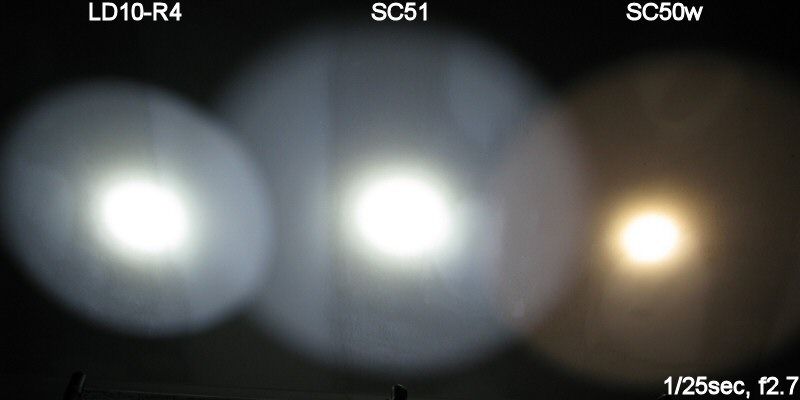
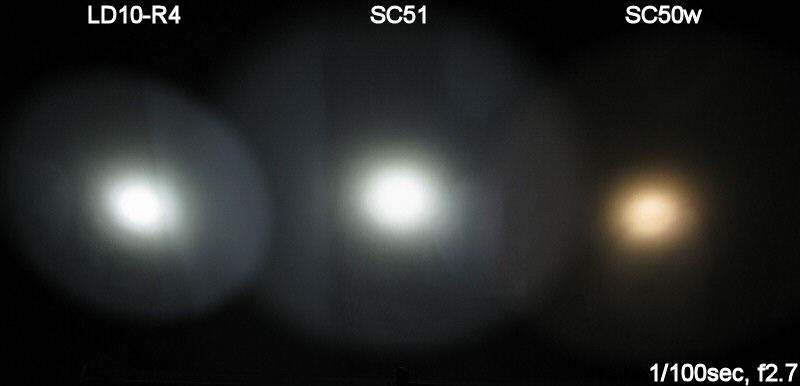
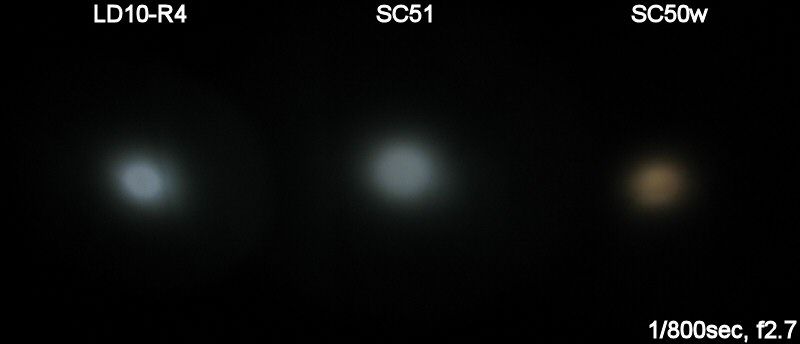
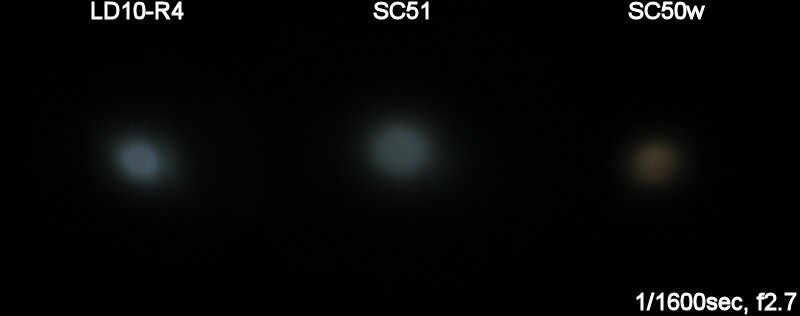
Although the un-primed drywall makes things a bit messy, you can see that the SC50/SC51 have a wider beam profile than the Fenix LD10-R4. Throw on the Zebralights are reasonable for this class.
For an explanation and discussion of the various tints – including outdoor shots comparing how they look – please see my 4Sevens Mini Tint Comparison - Warm, Neutral, Cool White . The SC50w is slightly warmer than the Mini Neutral used in that comparison, but you'll get the general idea.
User Interface
The Zebralights have a fairly unique user interface. While it may sound a little complex when first described, it is actually quite easy to use. Both the SC51 and SC50w function the same way, but there have been a few mode changes over time on the SC series.
On/off and mode switching is controlled by the electronic clicky switch. There are 6 possible output modes on either light, arranged in two sets of 3. Each output set is Lo – Med – Hi. There are two possible outputs at each level, commonly referred to as 1 or 2 (e.g. Lo1, Lo2, Med1, Med2, Hi1, Hi2). The light has independent mode memory to recall your preference at each of the Lo, Med, Hi levels.
The SC50 series features a 2Hz strobe mode as the secondary Hi, and lacks a memory feature at this level (i.e. Hi1 constant output is the only memorized option). The updated SC50+ series features a 107 Lumen secondary Hi on 14500 only, as well a slightly brighter primary Med mode on both standard AA batteries (NiMH, alkaline, L91) and 14500.
The SC51 has dispensed with the strobe mode altogether, and has a constant output secondary Hi mode on all batteries. Mode memory has been re-enabled at this level (i.e. you can select and memorize either Hi1 or Hi2)
From Off, a quick click turns on the light to Hi1 (SC50/SC50+) or your preferred Hi (SC51) instantly. Click quickly again to cycle from Hi to Med, and Low. You need to perform these clicks rapidly if you want to switch modes this way (i.e. from Off, single-click is Hi, double-click is Med, triple-click is Lo). After about a second or so of being On, a quick click will simply turn the light off.
Alternatively, from Off, a slightly longer press and hold (i.e. >0.5 sec) turns on the light to your preferred Lo mode.
To advance from one mode to the next while the light is On, press and hold to cycle through Lo, Med and Hi, repeatedly (you can do this directly from Off too). Release the switch to select the level. As before, a quick click turns off the light.
Double click at any level to toggle between the two sub-levels for that level (i.e. 1 or 2). The light will memorize your choice and return to it next time you cycle or turn on at this level (except for Strobe on the SC50/SC50+). The memory even lasts through battery changes.
And that's it – it is really very simple. Once you get used to the timings, you can basically have the light do anything you want, with your preferred Lo and Hi being the most directly accessible from Off.
Strobe/PWM:
SC50w:
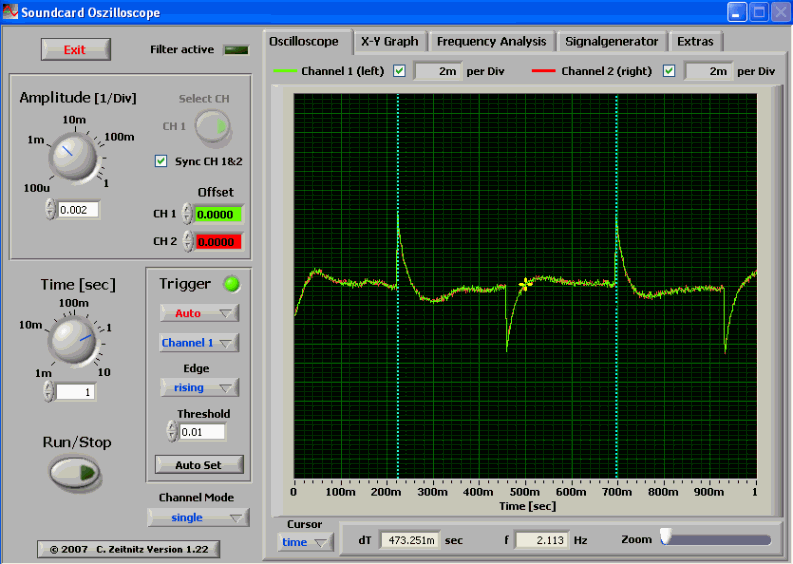
The SC50/SC50+ strobe mode is a refreshingly slow "signaling" strobe of 2Hz. For once, we don't have to put up with nauseating "tacticool" strobes on a 1xAA light.
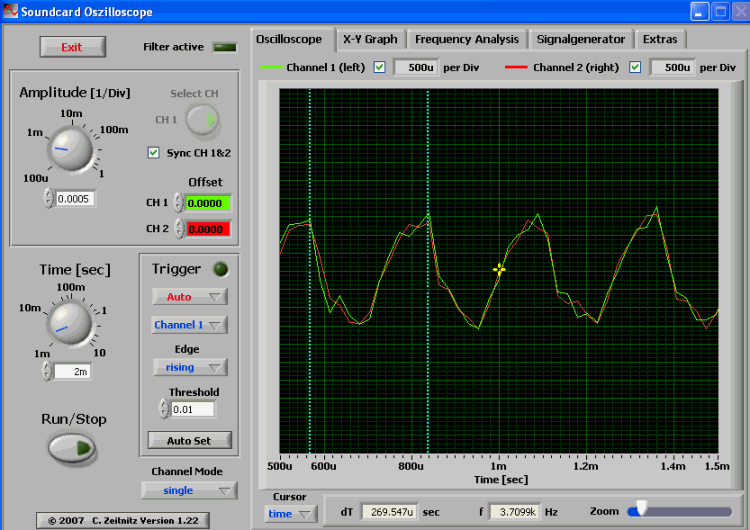
On the SC30/H31 series lights I reviewed previously, PWM was in the visible range on the secondary output modes (Lo2, Med2, Hi2) – typically 120-900 Hz. I am happy to report my SC50w sample only has measurable PWM on the Med2 level – and at an extremely high 3.7 kHz. :thumbsup:
SC51:
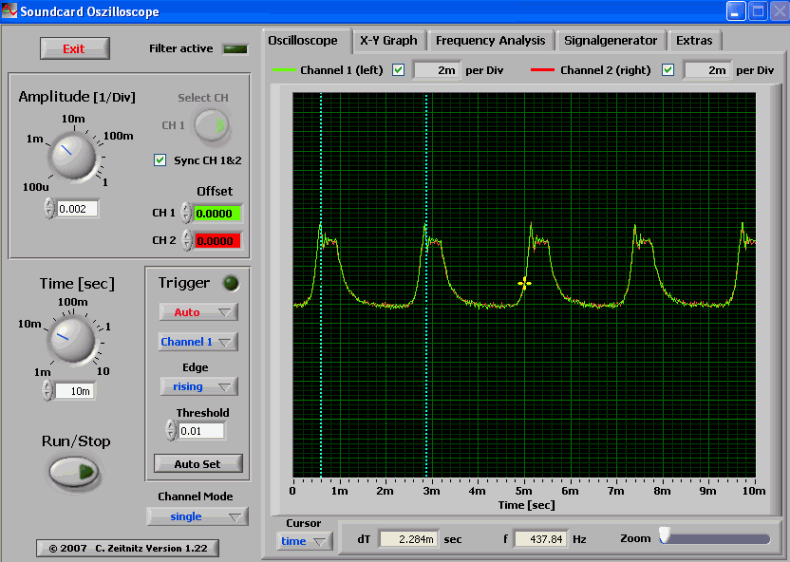
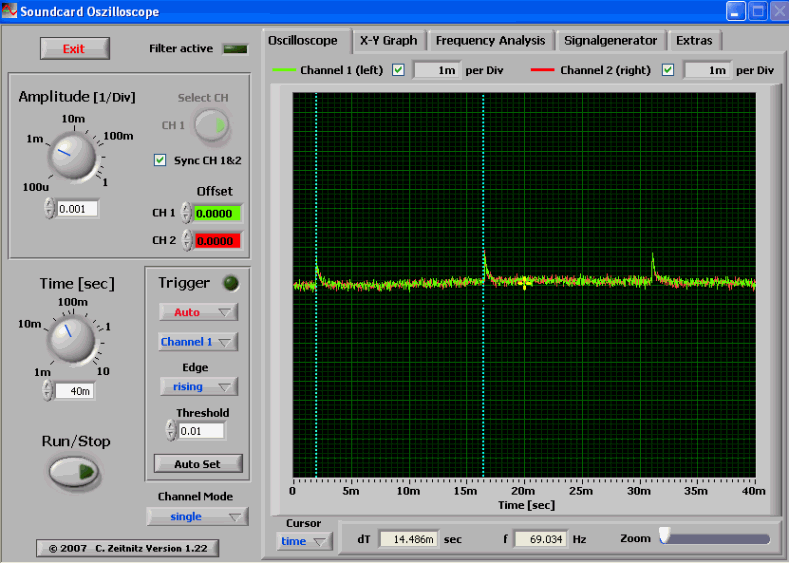
However, I am sad to report that the SC51 has reverted to visible PWM on Lo2 and Med2 levels. :sigh: Worse than that, the Lo2 mode is at a very visible 69 Hz (the Med2 is not as bad at 437 Hz).
This might have something to do with moving to the XP-G emitter, but I am sad to see a return to the low PWM freq – and one that is about half as fast as the older SC30/H31.
Parasitic Stanby Drain:
On the SC30/H31 lights, parasitic drain was typically sufficient to drain a fully charged cell in 1 year (for RCR) or 3 years (for primary CR123A). So how do these 1xAA brethren fare? The following were measured using a DMM:
SC50w: 7.4 uA on 14500, 2.3 uA on Eneloop NiMH
SC51: 41.8 uA on 14500, 14.2 uA on Eneloop NiMH
Assuming a standard 900mAh protected 14500, and a 2000mAh Eneloop NiMH, these currents would translate into:
SC50w: 13.9 years on 14500, 99.3 years on Eneloopoo:
SC51: 2.5 years on 14500, 16.1 years on Eneloop
Clearly, the SC50w drain is absolutely nothing to worry about. While the drain is higher on the SC51 it is still very good – certainly better than the earlier SC30 series. :thumbsup:
Testing Method: All my output numbers are relative for my home-made light box setup, a la Quickbeam's flashlight reviews method. You can directly compare all my relative output values from different reviews - i.e. an output value of "10" in one graph is the same as "10" in another. All runtimes are done under a cooling fan.
Throw values were taken at 1 meter for all lights shown below.
Throw/Output Summary Chart:
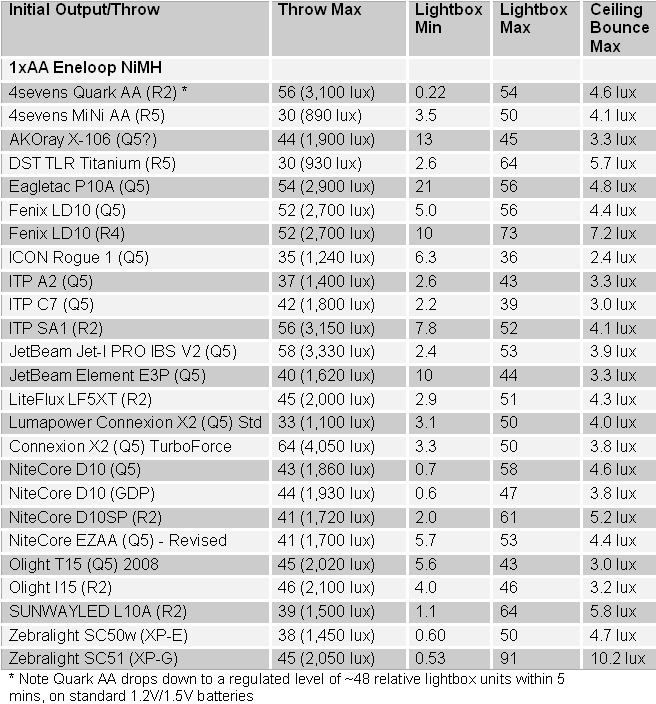
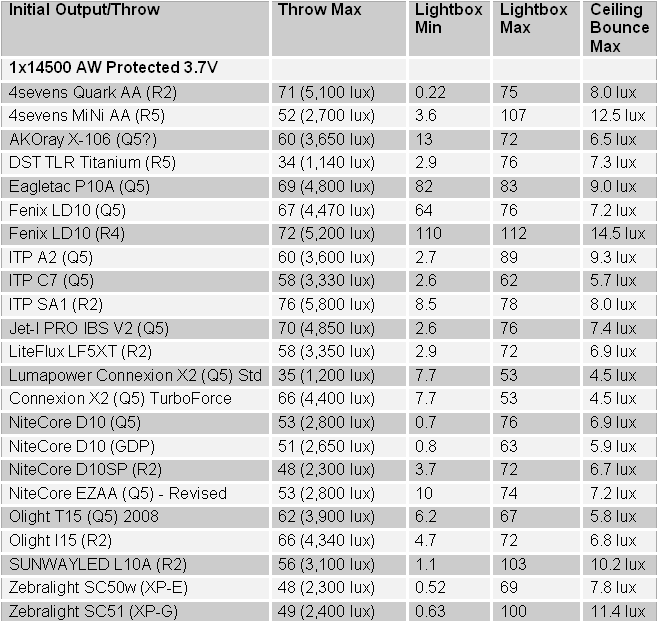
And no, those output numbers for the SC51 on Eneloop are not misprints!
Scroll down for a discussion ...
Output/Runtime Comparison
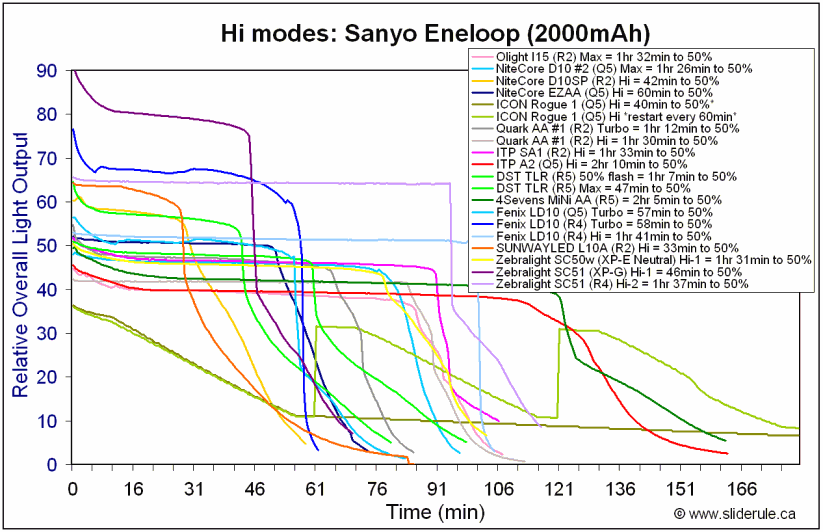
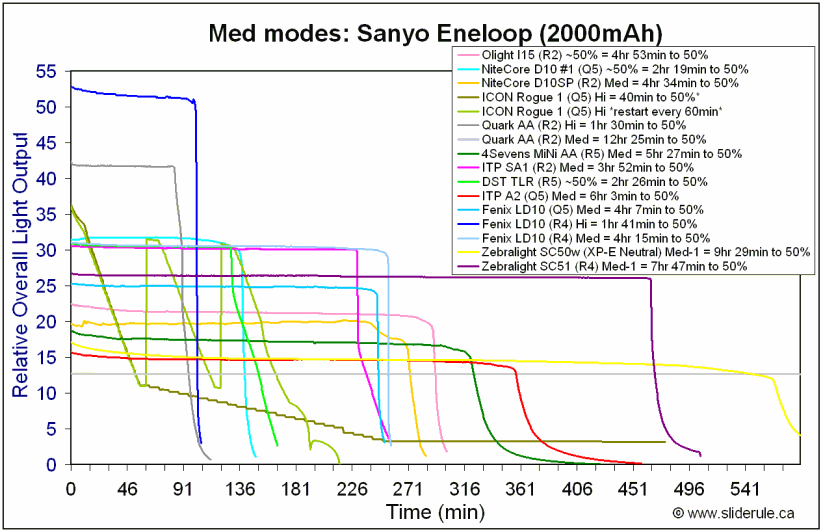

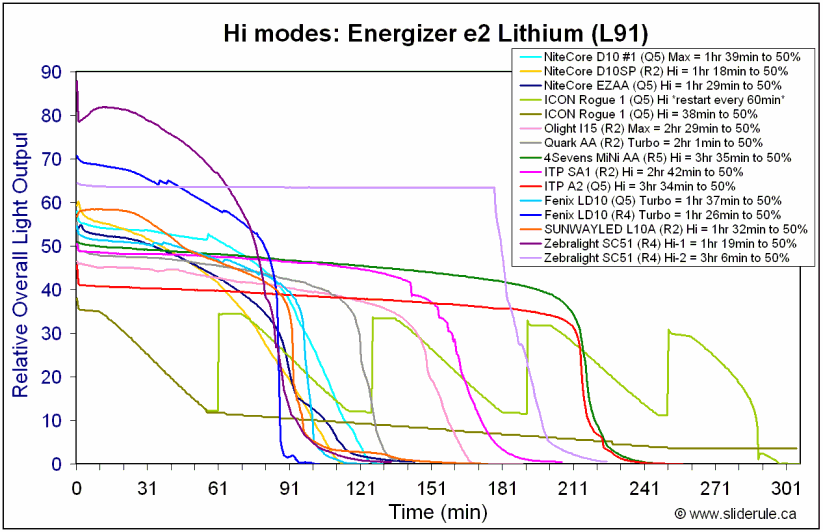
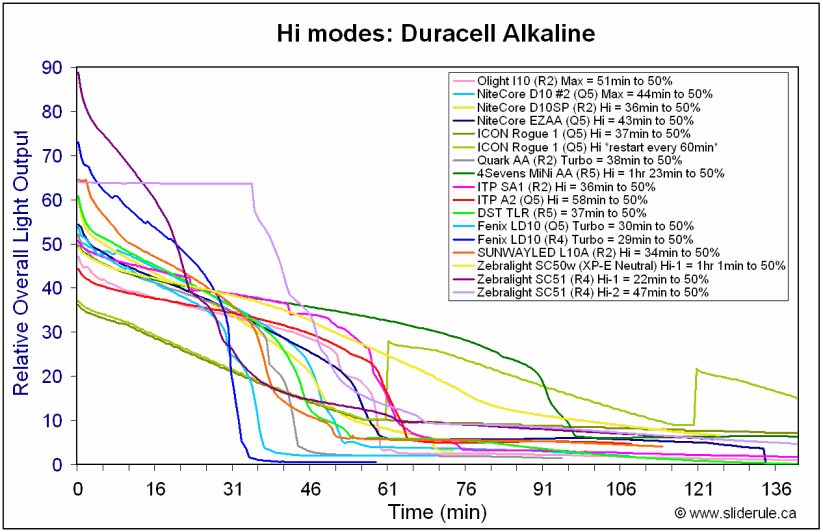

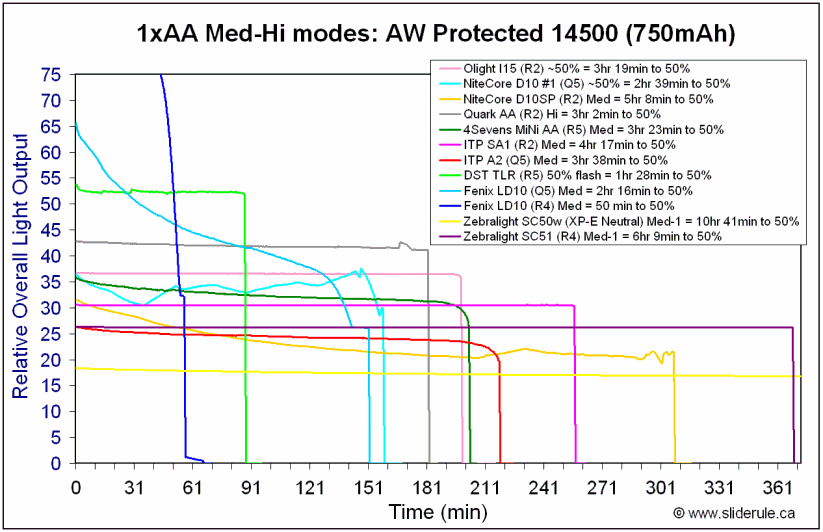
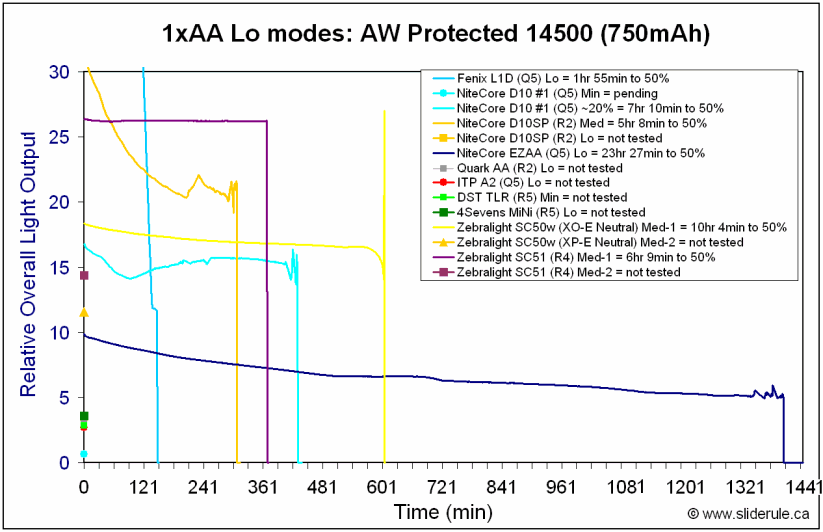
I don't know the output bin of the SC50w, but its performance is quite good for a neutral-white XP-E emitter. It certainly matches or exceeds most R2-equipped cool white lights in my collection. No surprises – all modes tested did very well on all batteries :thumbsup:
So how do you top that? Enter the SC51 - performance on standard batteries (Eneloop NiMH, alkalkine, L91) is simply outstanding.oo:
Zebralight informed me that the SC51 was optimized for standard batteries, but I wasn't expecting this kind of performance. Output/runtime efficiency clearly outperforms even the Fenix LD10-R4 – in some cases by as much as 50% or more! Max output is also noticeably higher than the Fenix (which was itself head-and-shoulders above the other lights in my collection). The Eneloop, L91 and alkaline graphs all tell the story pretty well!
So has the SC51 skimped on 14500 performance? Not all – in fact, I would say it performs as well as any other light given the R4 output bin.
Something else to note – the regulation pattern (on all batteries) is excellent – perfectly flat in all cases except max output.
Potential Issues
The lights use PWM for the lower outputs of the Med/Lo settings. On the SC50w, I was unable to detect the frequency on Lo, and found a virtually undetectable 3.7 kHz on Med. However, the SC51 has a very noticeable 69 Hz on the lower Lo, and a more reasonable 437 Hz on the lower Med.
Although my SC50w took all my AW protected 14500 (including the older flat-top ones), my SC51 wouldn't light up on any of them initially. I had to use a small magnet spacer on the positive contact pole of the battery for it to work. I don't know if this is natural variability, or if there's been a circuit change on the SC51. I note there is a quick flash when first making battery contact on the SC51, something that I do not see on the SC50w.
A parasitic standby current is needed for the electronic switch, but the levels are not a concern for either light (i.e. several years, to decades, of battery life). And in any case, the light can be easily locked-out by a twist of the tailcap.
UPDATE January 7, 2011: Having EDCed the SC50w for several months now, I can tell you of another issue - the light easily turns on if something presses against the switch in your holster/pocket. You need to lock the light out at the tailcap to prevent this. Otherwise, you may notice some heat coming from your pants - the light usually comes on in Max with a quick press. I've also had a few cases of finding it on Lo/Med, with a nearly depleted battery after being on for hours.
Preliminary Observations
To start, I found that the SC50w performed admirably – and consistently - on all battery sources. Although Zebralight doesn't provide an output bin for its XP-E emitter, I'd estimate somewhere around a R2 output level compared to other lights I've tested. I'm not generally a huge fan of neutral-warm tints, but I like the 5B4 tint bin of the SC50w.
Some of the small issues that detracted from the 1xCR123A-based H31/SC30 Zebralights I recently reviewed have been fixed. The standby current has been reduced to negligible levels (i.e. 14/99 years before draining a 14500/Eneloop). The PWM has been raised to virtually undetectable levels (i.e. 3.7 kHz on lower Med, unmeasurable on lower Lo).
Basically, the SC50w is great little 1xAA light. I've been EDCing it for the last month, and have been happy with its performance.
But it is also on the verge of being replaced by the SC51 – sporting the new XP-G R4. More than that, the SC51's circuit has been tweaked for outstanding standard battery performance (i.e. Eneloop, NiMH, alklakine, L91 lithium).oo:
I'm frankly at a loss … I don't understand how Zebralight has managed to pull off this sort of performance. :thinking: The SC51 blows away every XP-E light in my collection – both in terms of output/runtime efficeincy, and max output. For goodness sakes, it's max output on Eneloop is higher than most modern 1xAA lights on 14500!
And 14500 performance is still fine on the SC51 – while not as outstanding as the standard battery runtimes, it is consistent with a R4 output bin. Note though that I typically needed to use a small magnet spacer for the protected 14500s to make contact in the SC51 (something I didn't need on the SC50w). Not sure why - the lights look to be the same build.
If this sort of performance is the wave of the future, I'm looking forward to more XP-G based 1xAA lights!
----
UPDATE 9/11/2010: I've gotten some updates from Zebralight on the issues identified for the SC51 in the review:
SC50w was provided by GoingGear.com for review. SC51 was provided by Zebralight for review.
Warning: Pic heavy, as usual.
Zebralight has gone through a couple of iterations of the 1xAA forward-projecting SC50 model flashlight – although most of these have been relatively minor circuit tweaks.
For this review, I have on hand a late model neutral-white XP-E emitter SC50w from just before the introduction of the SC50w+ version. Not much has changed - the "+" version has a new secondary Hi mode on 14500 instead of strobe (107 Lumen), and slightly brighter primary Med mode (36 instead of 33 Lumens) on both standard AA and 14500. But otherwise, the build is identical.
I also have a soon-to-be-released new SC51 cool-white sample.
The SC51 uses the newer XP-G emitter (R4 output bin), but is otherwise identical in build to the SC50 line. The circuit seems similar to the SC50w, although strobe is no longer present at all (i.e. the secondary Hi mode is available on both standard AA and 14500). SC50w+ Specifications (taken from Zebralight):
- LED: Cree XP-E Neutral White (color temperature 4000-4300 K)
- User Selectable Modes: 3 (High, Medium and Low). Each mode can be configured to one of the two sub-levels.
- Light output values are out the front (OTF) Lumens.
- AA (alkaline/NiMH/lithium, runtimes based on Sanyo 2700mAh NiMH)
- High: 107 Lm (2.3 hrs) or 2Hz strobe
- Medium: 36 Lm (10.5 hrs) or 18 Lm (21.4 hrs)
- Low: 4.4 Lm (4 days) or 0.6 Lm (22 days)
- 14500: Outputs same as above, except the the SC50w+ features a 169 Lm max output and a 107 Lm output as the secondary High mode (i.e. instead of 2 Hz strobe, which is still present on regular AA).
- Battery: One AA size alkaline, 1.5V lithium primary, NiMH rechargeable, or 3.7v 14500 Li-ion rechargeable. Batteries are not included in the package.
- Parasitic Current Drain: 5.6uA, equivalent to 55 years of battery life.
- Beam Type: 76° spill beam spread, 8.6° (3 feet at 20 feet) hot spot
- Dimensions: Diameter: 0.85 inch (22 mm), Length: 3.15 inch (80 mm)
- Weight: 1.3 oz (36.5 gram) with clip, without battery or headband
- Electronic soft-touch switch, with a 200,000 cycle operating life
- Smart user interface provides fast and easy access to all brightness levels
- Precision machined casing from premium grade Alcoa aluminum bar stock
- Proprietary heat sinking design bonds the LED metal core board directly to the uni-body aluminum casing, providing unblocked thermal paths to over 94% of the surface area.
- Durable natural hard anodized finish (Type III Class I)
- SCHOTT ultra clear lens with anti-reflection coatings on both sides
- Bezel down clip (pre-installed)
- Can be used as a headlamp with the included headband (clip can remain installed when the light is on the headband)
- Orange peel textured reflector
- Anti-roll and tail-stand capable
- Battery power can be locked out by slightly unscrewing the tailcap to prevent unwanted activations or parasitic drain
- Waterproof to IPX8
- Accessories in the package: One black silicone holder with headband, two o-rings
- Estimated MSRP: $59
- LED: Cree XP-G Cool White (color temperature 6100-6500 K)
- User Selectable Modes: 3 (High, Medium and Low). Each mode can be configured to one of the two sub-levels.
- Light Output
- High: H1 200 Lm (0.9 hrs) or H2 140 Lm (2 hrs)
- Medium: M1 30 Lm (12 hrs) or M2 8 Lm (39 hrs)
- Low: L1 2.5 Lm (3 days) or L2 0.2 Lm (16 days)
- Light output are out the front (OTF) values. Runtime tests are done using Sanyo 2000mAh Eneloop AA batteries.
- Voltages: 0.7V - 2.5V
- Battery: One 1.5V AA (NiMH, lithium or alkaline). 14500 Li-ion batteries are not supported. Batteries are not included in the package.
- Parasitic Drain: Negligible (equivalent to 16 years)
- Beam Type: 80° spill beam spread, 11° (3.8 feet at 20 feet) hot spot
- Waterproof to IPX8 (1 meter 30 minutes)
- Estimated MSRP: $64
For both lights, included in the simple but firm cardboard box was the light with removable clip (attached), extra o-rings, and a one-page instruction sheet. The SC50w also came with the classic Zebralight headband with soft plastic light holder (shown above) – but the SC51 sample was lacking this accessory.
From left to right: Duracell alkaline, Zebralight SC51, SC50w, 4Sevens Quark Mini AA, Quark AA, NiteCore D10-SP, Fenix LD10-R4, ITP SA1
SC50w: Weight: 37.8g (no battery), Width (bezel) 22.4mm, (tailcap) 21.4mm, Length 80.5mm
SC51: Weight: 37.4g (no battery), Width (bezel) 22.4mm, (tailcap) 21.4mm, Length 80.5mm
As you can see, the SC50/51 series is quite tiny.
The overall dimensions of the SC51 are exactly the same as the earlier SC50/SC50+ series – it's only the emitter that appears different (XP-G on the SC51 instead of XP-E on the earlier models). SC50w first, followed by SC51:
The SC51 sample I have uses a XP-G emitter with R4 output bin. The SC50w doesn't specify an output bin for the XP-E emitter, but I understand from Zebralight that the Neutral white version currently comes from a 5B4 tint bin.
Reflectors look identical, and are medium textured (medium orange peel), and a reasonable depth for this size light.
The lights have flat-bottomed tailcaps and electronic control switches on their heads. The switches are covered with textured boot covers, and are easy to access. Feel of the switches are good for this type, with a lightly audible click as you make contact. Note that electronic switches are not like traditional mechanical clickies – think more like the buttons on your DVD player, flat-screen monitor, etc.
Tailcap threads are anodized, allowing for tailcap lockout. :thumbsup: This is important on all lights with electronic switches, since there is always some parasitic stand-by current drain to allow the switch to function. Scroll down for a discussion in this case.
The lights can both tailstand and headstand.
The lights come with a removable metal pocket clip, held in place by two regular Phillips head screws.
Fit and finish on both of my samples are excellent. I really like the color – the SC51 is slightly darker than my SC50w specimen, but that is just natural anodizing lot variability. Either way, I personally quite like dark green-grey color. In both cases, the tailcaps are well-matched to the bodies. The overall effect is very similar to a number of Nitecore, JetBeam and SUNWAYLED lights. I would consider the anodizing of Zebralights to be in the same category as those makers. :twothumbs
One interesting feature – absolutely no identifying or warning labels of any sort on either light. Kind of a refreshing change, to be honest.
There is little ridge detail or knurling, so I recommend you keep the clip on these lights. The heatsinking fins around the head do provide some additional grip, though.
Beamshots
Sorry for the quality of the beamshots – I've recently moved, and haven't had a chance to set up a proper beamshot closet yet. What you are looking at below is un-primed drywall, with a range of spakle/sanding marks.
All lights are on Max, ~0.5m from a white wall on Sanyo Eneloop. The camera was set to automatic white balance, and the SC50w doesn't look that warm in real life.
Although the un-primed drywall makes things a bit messy, you can see that the SC50/SC51 have a wider beam profile than the Fenix LD10-R4. Throw on the Zebralights are reasonable for this class.
For an explanation and discussion of the various tints – including outdoor shots comparing how they look – please see my 4Sevens Mini Tint Comparison - Warm, Neutral, Cool White . The SC50w is slightly warmer than the Mini Neutral used in that comparison, but you'll get the general idea.
User Interface
The Zebralights have a fairly unique user interface. While it may sound a little complex when first described, it is actually quite easy to use. Both the SC51 and SC50w function the same way, but there have been a few mode changes over time on the SC series.
On/off and mode switching is controlled by the electronic clicky switch. There are 6 possible output modes on either light, arranged in two sets of 3. Each output set is Lo – Med – Hi. There are two possible outputs at each level, commonly referred to as 1 or 2 (e.g. Lo1, Lo2, Med1, Med2, Hi1, Hi2). The light has independent mode memory to recall your preference at each of the Lo, Med, Hi levels.
The SC50 series features a 2Hz strobe mode as the secondary Hi, and lacks a memory feature at this level (i.e. Hi1 constant output is the only memorized option). The updated SC50+ series features a 107 Lumen secondary Hi on 14500 only, as well a slightly brighter primary Med mode on both standard AA batteries (NiMH, alkaline, L91) and 14500.
The SC51 has dispensed with the strobe mode altogether, and has a constant output secondary Hi mode on all batteries. Mode memory has been re-enabled at this level (i.e. you can select and memorize either Hi1 or Hi2)
From Off, a quick click turns on the light to Hi1 (SC50/SC50+) or your preferred Hi (SC51) instantly. Click quickly again to cycle from Hi to Med, and Low. You need to perform these clicks rapidly if you want to switch modes this way (i.e. from Off, single-click is Hi, double-click is Med, triple-click is Lo). After about a second or so of being On, a quick click will simply turn the light off.
Alternatively, from Off, a slightly longer press and hold (i.e. >0.5 sec) turns on the light to your preferred Lo mode.
To advance from one mode to the next while the light is On, press and hold to cycle through Lo, Med and Hi, repeatedly (you can do this directly from Off too). Release the switch to select the level. As before, a quick click turns off the light.
Double click at any level to toggle between the two sub-levels for that level (i.e. 1 or 2). The light will memorize your choice and return to it next time you cycle or turn on at this level (except for Strobe on the SC50/SC50+). The memory even lasts through battery changes.
And that's it – it is really very simple. Once you get used to the timings, you can basically have the light do anything you want, with your preferred Lo and Hi being the most directly accessible from Off.
Strobe/PWM:
SC50w:
The SC50/SC50+ strobe mode is a refreshingly slow "signaling" strobe of 2Hz. For once, we don't have to put up with nauseating "tacticool" strobes on a 1xAA light.
On the SC30/H31 series lights I reviewed previously, PWM was in the visible range on the secondary output modes (Lo2, Med2, Hi2) – typically 120-900 Hz. I am happy to report my SC50w sample only has measurable PWM on the Med2 level – and at an extremely high 3.7 kHz. :thumbsup:
SC51:
However, I am sad to report that the SC51 has reverted to visible PWM on Lo2 and Med2 levels. :sigh: Worse than that, the Lo2 mode is at a very visible 69 Hz (the Med2 is not as bad at 437 Hz).
This might have something to do with moving to the XP-G emitter, but I am sad to see a return to the low PWM freq – and one that is about half as fast as the older SC30/H31.
Parasitic Stanby Drain:
On the SC30/H31 lights, parasitic drain was typically sufficient to drain a fully charged cell in 1 year (for RCR) or 3 years (for primary CR123A). So how do these 1xAA brethren fare? The following were measured using a DMM:
SC50w: 7.4 uA on 14500, 2.3 uA on Eneloop NiMH
SC51: 41.8 uA on 14500, 14.2 uA on Eneloop NiMH
Assuming a standard 900mAh protected 14500, and a 2000mAh Eneloop NiMH, these currents would translate into:
SC50w: 13.9 years on 14500, 99.3 years on Eneloop
oo:SC51: 2.5 years on 14500, 16.1 years on Eneloop
Clearly, the SC50w drain is absolutely nothing to worry about. While the drain is higher on the SC51 it is still very good – certainly better than the earlier SC30 series. :thumbsup:
Testing Method: All my output numbers are relative for my home-made light box setup, a la Quickbeam's flashlight reviews method. You can directly compare all my relative output values from different reviews - i.e. an output value of "10" in one graph is the same as "10" in another. All runtimes are done under a cooling fan.
Throw values were taken at 1 meter for all lights shown below.
Throw/Output Summary Chart:
And no, those output numbers for the SC51 on Eneloop are not misprints!
Scroll down for a discussion ...
Output/Runtime Comparison
I don't know the output bin of the SC50w, but its performance is quite good for a neutral-white XP-E emitter. It certainly matches or exceeds most R2-equipped cool white lights in my collection. No surprises – all modes tested did very well on all batteries :thumbsup:
So how do you top that? Enter the SC51 - performance on standard batteries (Eneloop NiMH, alkalkine, L91) is simply outstanding.
oo:Zebralight informed me that the SC51 was optimized for standard batteries, but I wasn't expecting this kind of performance. Output/runtime efficiency clearly outperforms even the Fenix LD10-R4 – in some cases by as much as 50% or more! Max output is also noticeably higher than the Fenix (which was itself head-and-shoulders above the other lights in my collection). The Eneloop, L91 and alkaline graphs all tell the story pretty well!
So has the SC51 skimped on 14500 performance? Not all – in fact, I would say it performs as well as any other light given the R4 output bin.
Something else to note – the regulation pattern (on all batteries) is excellent – perfectly flat in all cases except max output.
Potential Issues
The lights use PWM for the lower outputs of the Med/Lo settings. On the SC50w, I was unable to detect the frequency on Lo, and found a virtually undetectable 3.7 kHz on Med. However, the SC51 has a very noticeable 69 Hz on the lower Lo, and a more reasonable 437 Hz on the lower Med.
Although my SC50w took all my AW protected 14500 (including the older flat-top ones), my SC51 wouldn't light up on any of them initially. I had to use a small magnet spacer on the positive contact pole of the battery for it to work. I don't know if this is natural variability, or if there's been a circuit change on the SC51. I note there is a quick flash when first making battery contact on the SC51, something that I do not see on the SC50w.
A parasitic standby current is needed for the electronic switch, but the levels are not a concern for either light (i.e. several years, to decades, of battery life). And in any case, the light can be easily locked-out by a twist of the tailcap.
UPDATE January 7, 2011: Having EDCed the SC50w for several months now, I can tell you of another issue - the light easily turns on if something presses against the switch in your holster/pocket. You need to lock the light out at the tailcap to prevent this. Otherwise, you may notice some heat coming from your pants - the light usually comes on in Max with a quick press.
I've also had a few cases of finding it on Lo/Med, with a nearly depleted battery after being on for hours.Preliminary Observations
To start, I found that the SC50w performed admirably – and consistently - on all battery sources. Although Zebralight doesn't provide an output bin for its XP-E emitter, I'd estimate somewhere around a R2 output level compared to other lights I've tested. I'm not generally a huge fan of neutral-warm tints, but I like the 5B4 tint bin of the SC50w.
Some of the small issues that detracted from the 1xCR123A-based H31/SC30 Zebralights I recently reviewed have been fixed. The standby current has been reduced to negligible levels (i.e. 14/99 years before draining a 14500/Eneloop). The PWM has been raised to virtually undetectable levels (i.e. 3.7 kHz on lower Med, unmeasurable on lower Lo).
Basically, the SC50w is great little 1xAA light. I've been EDCing it for the last month, and have been happy with its performance.
But it is also on the verge of being replaced by the SC51 – sporting the new XP-G R4. More than that, the SC51's circuit has been tweaked for outstanding standard battery performance (i.e. Eneloop, NiMH, alklakine, L91 lithium).
oo:I'm frankly at a loss … I don't understand how Zebralight has managed to pull off this sort of performance. :thinking: The SC51 blows away every XP-E light in my collection – both in terms of output/runtime efficeincy, and max output. For goodness sakes, it's max output on Eneloop is higher than most modern 1xAA lights on 14500!
And 14500 performance is still fine on the SC51 – while not as outstanding as the standard battery runtimes, it is consistent with a R4 output bin. Note though that I typically needed to use a small magnet spacer for the protected 14500s to make contact in the SC51 (something I didn't need on the SC50w). Not sure why - the lights look to be the same build.
If this sort of performance is the wave of the future, I'm looking forward to more XP-G based 1xAA lights!
----
UPDATE 9/11/2010: I've gotten some updates from Zebralight on the issues identified for the SC51 in the review:
- The H51 and SC51 share the same circuit (a buck-boost, that has been heavily optimized since the original H50)
- My engineering sample had a lower PWM, but the final shipping version should be close to those found in the SC30/H31 (i.e. twice what I found on the SC51).
- ZL explains that they use lower freq PWM in the Low2 level for improved circuit efficiency. They claim to be able to filter out the visible PWM with the capacitor in the output stage, even though the PWM may still be detectable by oscilloscope.
- The positive contacts used in the SC51 are simply from a new batch, which presumably explains the heightened sensitivity to flat tops. Nothing is changed in terms of positive polarity detection.
- ZL confirmed that parasitic drain is lower on the AA-series lights, compared to their other offerings. They say they will try to implement this feature on the SC30/SC60/H31 lights in the future.
- One minor difference between the SC50 and SC51 that I didn't note - the threading is a bit thicker now - 1.25mm pitch. In addition to the same circuit, the SC51 and H51 also use the same thread, and tailcap.
SC50w was provided by GoingGear.com for review. SC51 was provided by Zebralight for review.
Last edited:


 .
.


