What did you use your flashlight for today?

Candle Power Forums

Help Support Candle Power:

Used the BOSS 70 to illuminate how dusty my nephew's room was. Told him to keep vacuuming.
Used my Fenix LR35R Pro for the same thing last week. I have vacation now, so I'm helping my mother doing a summer cleaning, and I noticed the default nozzle almost didn't remove anything from the floor (Karcher T 11/1 Hepa). So I took over, and changed the nozzle to something more narrow with the light laying on the floor, easily illuminating where the dust was.

Which is why I like calling vacuums "dust-evacs" - evacuating the dust to a more suitable location.

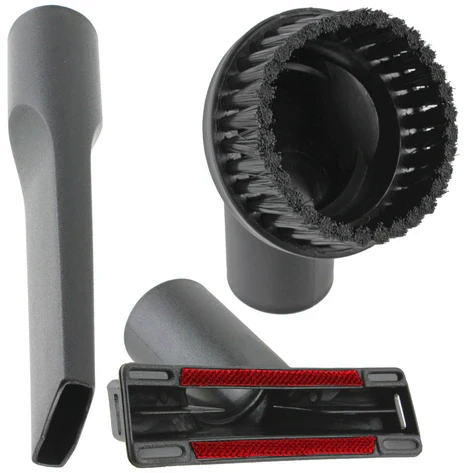
Seriously though, everyone should get a kit like this (I used the bottom carpet / upholstery nozzle):

1784795252261.png

Buying as cheap as possible, it doesn't matter - it is still better than the default combi nozzle. I am also a big fan of using a brush nozzle on the walls.
I have bought several such kits, both as spares and one reserved for the floor and another (assuming the floor is more dirty) for the furniture.

I also keep different nozzle sets in separate boxes, for the separate vacuums (Karcher T11, WD 4 and WD 6) for different uses. That way I won't accidentally use the nozzle that was just in the car or in the garage on a living room carpet.

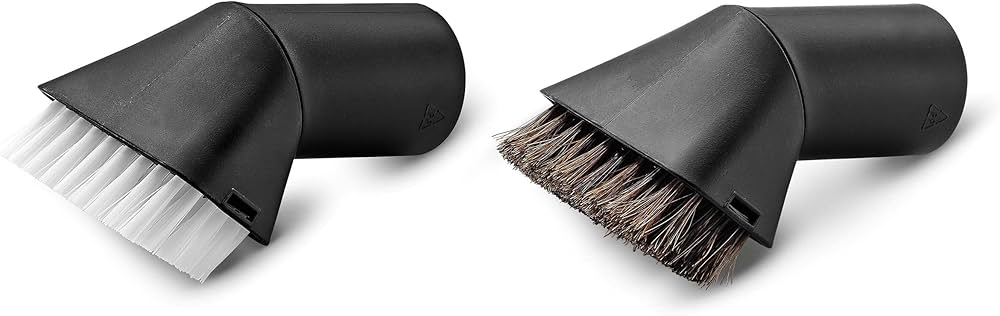
Don't like the soft Karcher brush (black one below - the strands are too close, so the vacuum just sucks them back and clogs the opening. The Nilfisk version, like the round one above, has a larger opening and is much better. It also fits karcher vacuums), but the stiffer white one works great on window sills (where bugs like to make a mess).

1784795831792.png
 
Last edited:
We had a brief power outage this evening lasting about 8 seconds. It was enough to knock our network connection offline, and one of our devices wasn't booting back up properly.
Over the years I have lost 2 modems, a switch, a harddrive and a motherboard to power surges. Now I have an UPS on everything. One for the main PC, one for the central network gear, and a third for the server.

We get a blackout roughly 3 times a year, plus any informed in advance downtime due to maintenance. Is that worth spending some 1000 USD, pluss 400 USD every 3 years on new batteries? Arguably not. I do like the peace of mind though. And the 960 W on-line UPS for the main PC also cleans the voltage, so the PSU gets less stress handling any spikes or ripples it may get.

Main one gives a runtime of about 15 minutes - a few minutes before that (programmable in the UPS software), it automatically hibernates the machine (I have everything running 24/7) if I am not present. Not long, but when we get a blackout, it either lasts a few seconds to a couple minutes or several hours. Either well within what the UPS can handle, or plenty of time to make a decision to make a controlled shutdown.
 
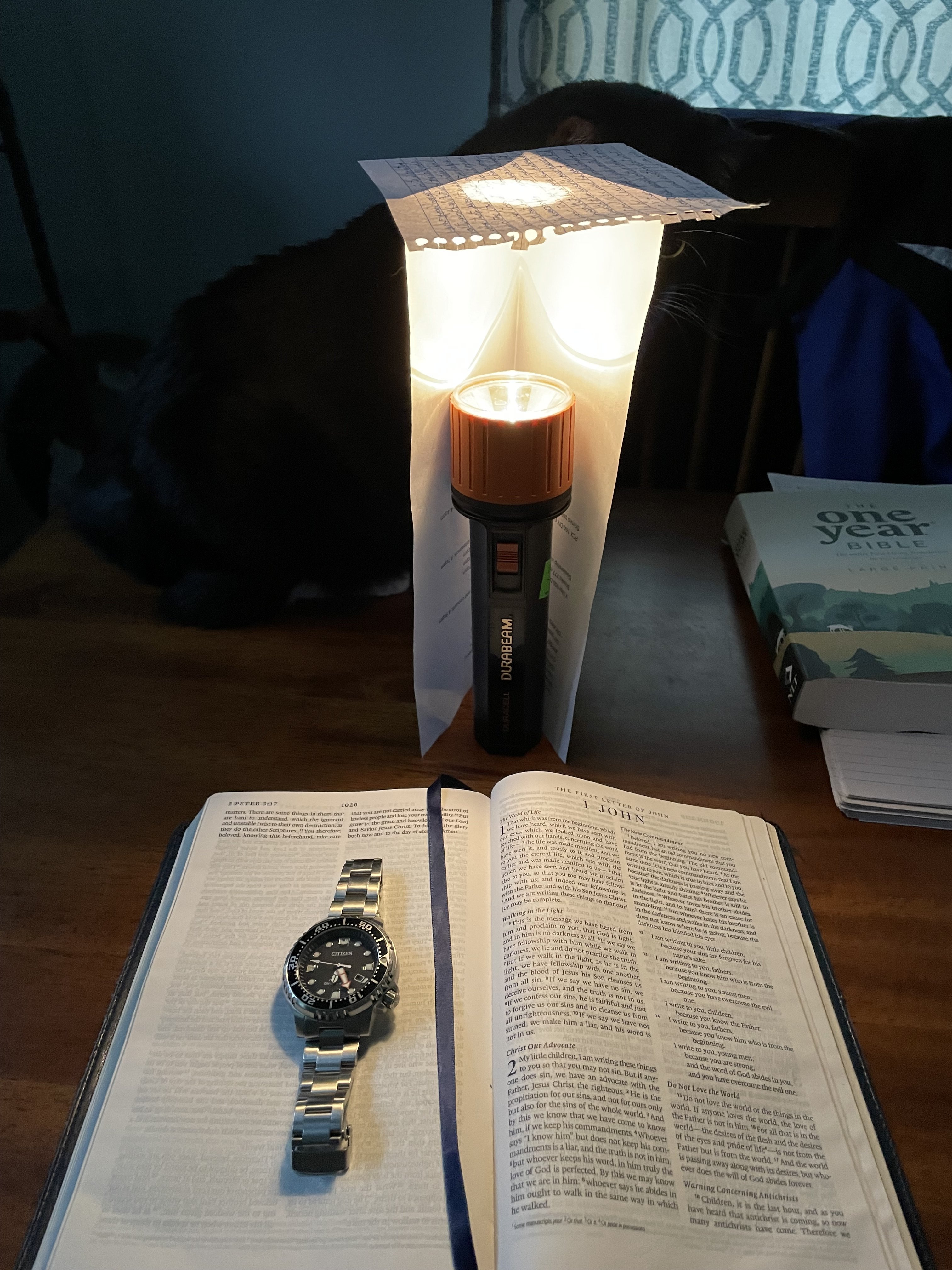
I'd never go into a room with lights on timers without a light source of my own. Learned that the not-so-hard way at the bathrooms of the clinic my mother gets treatment at. Not-so-hard because even the first time, I had a torch I could tailstand.
Yes, I now make it a point to always have a light on me whenever I'm away from my apartment. The Solitaire for navigating around the building. One of my two Nebo Newton Torchy 300s for running errands in the neighborhood where I live. Both have proven to be reliable. Other inexpensive lights for those purposes, have not.
 
I could be wrong, but I get the sense the mainstream 18650 lights are 1000 Lumen, whereas the mainstream 21700 lights are 3000 Lumen. That is a significant bump in output power. Also, I really like the extra runtime a 21700 light can get, with a 5000 mAh vs 3500 mAh battery.

And I don't have any regrets, having spent the last year going fully from 18650 to 21700. Still keeping a few 18650 lights for nostalgia, like my trusted Fenix PD35 v1, my very first Convoy (an ancient, but mandatory S2+) and a Wurkkos FC11C.
Blazing bright output isn't everything. It's a lot, but not everything. After more time using 21700-based lights than I can recall.... I'm going back to 18650s. I wear large-sized gloves. The 21700s have always been just a bit annoyingly too thick. Just enough that I'm fed-up with holding them. The 18650s definitely feel better in my hands.

Also, I've never been comfortable with losing dual-fuel capability after switching over to 21700s. With an 18650 light, if the battery dies, I can just swap it out for a pair of CR123 primaries and keep going. While I'll freely admit that most of the time, that's not going to be an issue.... None of us can predict when a Blackout will occur or how long it will last. Certainly no one predicted the massive one that hit in 2003. Upstate New York, it lasted for several hours. In Astoria Queens, in the neighborhood containing the HUGE Con-Edison electrical complex in NYC. It lasted over 10 days! I like having primaries I can use as back-up.

Tried switching to rechargeables back in the day when CPF had significantly more members. Others found success. I did not. One member, I will never forget this.... He owned two SureFire models back in the day. One was possibly a 9N. The other was definitely an L7. He used them on the job as a movie Usher. Had no desire to buy any other SureFire models. Certainly not the ones that took lithium primaries. It's unfortunate because today, both his SureFires are likely sitting around, not getting used. Those older battery sticks from Streamlight, SureFire, and Maglite.... nope. Didn't work well for me. Back to lights running off of mainly 2xCR123 lithium primaries. Tried again years later, same result. Just unreliable for me. Massive number of members back then, guaranteed I was the last hold-out on CPF. Still using primaries. Then rechargeable technology actually got reliable, so I switched yet again. But, won't lie. I like keeping a foot in the Primary world. Just in case things go South.

My main light is now a Wurkkos FC12C. This 18650 light is much better than it has any right to be! Bought it because I wanted a new 18650 light after deciding I had enough of 21700s. And, it was on sale over at the company's official website, and I mean a really sweet discount! It has blown me away. Oddly, reviewers claim it puts out a very narrow beam. NOPE! Puts out a useful beam that is a good compromise of both flood and throw. My favorite kind of beam. That was a nice surprise.

My back-up light is my 2AAA Powertac Sabre model. I keep rechargeable eneloops in it. If those die on me, pop a couple of AAA alkalines in her. (Ironically, it was my father who unintentionally convinced me to try rechargeable AAs about a decade before he passed away. He swapped out all of the alkaline AA batteries in all of his electronic devices to rechargeble AAs. He never once complained about their performance. He wasn't a big fan of change, either. So for him to change anything; that was a big deal.) I'm seriously considering swapping out my keychain light to a single-AAA model for the same reason. Eneloop most of the time, alkaline for Emergency use. Front-runner for that task is a black aluminum Peak Eiger. Those aluminum Peaks feel like they weigh less than a feather. The easily removeable key-ring attachment is a nice bonus. No need to walk around with all of your keys in hand while using the light.

Speaking of output, yes 21700s are brighter on the highest setting. However, sustainability just isn't there beyond 30 seconds withour risking damaging the emitter if you use Turbo mode often. Same issue with 18650s. But again, you get the advantages mentioned above. As far as overall output, no; speaking from experience that gap isn't 1,000 lumens vs. 3,000. Not even close. That gap is much narrower. Due to that, I'll take slightly decreased output in exchange for the 18650's other advantages.
 
Blazing bright output isn't everything. It's a lot, but not everything. After more time using 21700-based lights than I can recall.... I'm going back to 18650s. I wear large-sized gloves. The 21700s have always been just a bit annoyingly too thick. Just enough that I'm fed-up with holding them. The 18650s definitely feel better in my hands.

Also, I've never been comfortable with losing dual-fuel capability after switching over to 21700s. With an 18650 light, if the battery dies, I can just swap it out for a pair of CR123 primaries and keep going. While I'll freely admit that most of the time, that's not going to be an issue.... None of us can predict when a Blackout will occur or how long it will last.

Speaking of output, yes 21700s are brighter on the highest setting. However, sustainability just isn't there beyond 30 seconds withour risking damaging the emitter if you use Turbo mode often. Same issue with 18650s. But again, you get the advantages mentioned above. As far as overall output, no; speaking from experience that gap isn't 1,000 lumens vs. 3,000. Not even close. That gap is much narrower. Due to that, I'll take slightly decreased output in exchange for the 18650's other advantages.
I want to take this moment to repeat how glad I am there is a light for everyone out there. 🙂

As for how they feel in the hand, I definitely prefer the thicker 21700 lights. Every single 18650 light I have tried have felt a bit too small in mine. I don't think I have unusually large hands, but finding a computer mouse that I can grip comfortably has been a challenge (I have tried so many that felt too narrow, that I had to hold in a cramping pinch-like grip). And it's been the same with 18650 lights - they feel fiddly, like I almsot keep dropping them because I can't get a good grip while being able to operate the side switch. Lights like the Convoy S21E feels much better.

Regarding runtime, I prefer multiple cells in parallel (like the Convoy 3X21-series, and Fenix TK75 / TK76). I bought a Thrunite Neutron 3C v2 (I think that was the name), which supports just about every cell imaginable up to a 18650 - and I've never needed it for just about anything, ever. I used a Fenix PD35 at the time, and I bought the Thrunite just to have a light that supported a mixed pack of Keeppower cells I had bought. This was like 2018, and I had no idea where my flashlight journey would take me yet.

I can't speak to the max output other than the average based on the lights I have looked at. I may very well be wrong. Most lights I looked at a couple years after buying the Fenix PD35 v1 were all 1000 Lumen at the time. I am sure that has increased now, as I do see many 18650 lights well into the 1500+ Lumen area. A 3000 Lumen Turbo was all I needed when I began going away from 18650, as all my 18650 lights all maxed out at around 1000 Lumen. And when the Acebeam EC50 gen. 2 did the 3000 Lumen Turbo I needed sometimes, well, suddenly only 1000 Lumen wasn't enough for me anymore.

But I have said many times I prefer runtime over maximum Turbo output. That said, if I need 3000 Lumen, and my 18650 lights only manages 1000, then I have to look elsewhere. And many of the 21700 lights I currently own can (at least on paper) do that. On that note, I am really disappointed in the Acebeam E75 519A 5000K version. It says 4500 Lumen Turbo, but it is not clear that only goes for the 6500K version. The 519A 5000K Turbo is 3000 Lumen, with a sustained 1000 Lumen.

All things considered, a 21700 light for me now offers longer runtime, higher Turbo, more options (physical size, emitters, design, even body colour) that I am interested in compared to 18650. I see the dual fuel argument, and I was down that path for a time, but I discovered that wasn't anything of practical use for me.

...Also, if I may be so blunt, local availability as far as brand options go outright sucks. I can get Fenix lights easily enough, some Nitecore models, some Led Lenser / Coast options - other than that, it's El Cheapo's or overpriced stuff like Black Diamond and Silva. Anything else, and it's from China - Convoy, Emisar etc.
 
Last edited:
I forgot.... Fenix PD35R ACE 18650 light is headed my way. Max. output 2,000 lumens.
Ooh, that is a nice light! Been looking at that one myself. If I were in that market right now, the PD36R Ace (21700 version) in Green would be strongly considered. Both models have that tail switch + side switch UI that I like the most.
 
The worst lightning damage I saw was at a transmitter site. Typical FL summertime nasty thunderstorm. Close lightning then all of our monitor TVs went blank for the MMDS transmitters. After the lightning let up a bit we drove over to the transmitter site and found part of the antenna on the ground, one end melted. The tower looked alright BUT the thick Heliax cable now had a large hole in it, where it made the 90 degree turn from vertical to horizontal as it made its way into the transmitter doghouse. Inside was a mess. We had a bunch of these TrippLite protectors on every outlet in the room. Every single one of them had s**t stains splattering the walls and floor around them. Some of them were no longer attached to the wall but were in pieces on the floor. It took us about two hours to clean up the mess in there, including replacing every outlet. We'd later replace the circuit breaker panel & breakers that month. After the cleanup, for fun I tried powering up one of the racks. The voltage regulator on the rack came online, no issues. I measured it extensively with and without a load (space heater) to make sure before connecting the real equipment. All of it came on, including the transmitter. Over the next couple of hours, we did some back-of-the-napkin math and built a new antenna with coat hangers, plumber's solder, and a blowtorch. I think we were back on-air within 4 hours.

Wow!! That's a great story. Do ypu have any pictures of that makeshift antenna? And that Heliax, was it pressurized?
 
My parents still have one! I used to use it all the time as a kid.
I recently cleaned and added DC-fix to it. My dad keeps it in one of his tool cabinets.
 
Wow!! That's a great story. Do ypu have any pictures of that makeshift antenna? And that Heliax, was it pressurized?
This was around 2000 or so, so I do have photos, but they're going to be in print form in storage.
Yes, the Heliax was pressurised. Because of the hole in it, along with significant melting, the entire run had to be replaced.

The irony was that the other engineer I was working with was hired due to a somewhat similar situation. He was working for a local cable company when a tower got hit by a tornado. So there he was, along with people from other companies, all on the same tower trying to restore service to their clients/customers. He started talking with one of the engineers, both of them hanging off the tower. Ultimately the guy told him to give him a call the next day and he'd hire him at a good pay raise from what he was earning. Done. So his entire job interview happened on the side of a tornado-damaged tower, at night.
 
Wow. That's a helluva way to show your resume. 😆
That’s not too dissimilar from how I got my first broadcasting job.

Even though I was a teenager, I had been appearing weekly as a guest on a talk show. After a few appearances, I asked whether they had any openings. It looked fun, and it was something I had never done before. They told me to stop by during the week, so I prepared a résumé and went in. The manager was on-air with about twenty minutes left in her show, so they brought me into the control room. The board operator introduced herself, then left for coffee during a commercial break.

I watched the commercials play, looked at the paper spot log, and counted down the timers: ninety seconds, sixty, thirty. Still no board op. At fifteen seconds, I looked over the console, identified which carts were loaded, figured out the correct channels, and, with two seconds remaining, started the next cart, crossfaded it in, and opened the microphones. The show continued without interruption.
The manager looked up and mouthed, “Where’s _______?" I gave her the universal shrug.

The board op returned about a minute later very panicked. After the show, there was a brief discussion about what had happened, a few questions about me, and that was it: hired.

It was an extraordinary experience. I was treated as an adult, and most of the people I worked with had no idea I was still in high school. I had only been sixteen for about a month when they hired me. I would later take half a day off for graduation and wrote it on the station calendar. By then, I was a lower-level manager overseeing about thirty people. One of the news staff asked, “So, what did you major in?” I explained that it was my high school graduation, although I was also dual-enrolled and only a few credits short of an associate degree and would get that afterwards. “You mean to tell me I’ve been taking s**t from a high school student all this time?”
“Yep,” I replied, somewhat sheepishly.

The place could be brutal. This was not a place for a child. I did not mind it then and still look upon it fondly. Perfection was not the goal; it was the requirement. I usually worked forty to sixty hours a week while attending high school and college, and at peak periods, eighty to one hundred. It kept me away from home, which, for me, was an absolute blessing.

I also moved beyond the job I was originally hired to do and into engineering and design. I began repurposing leading-edge equipment to perform far beyond its intended capabilities and developing technologies that major corporate laboratories were still researching with teams of engineers. I was doing my own R&D, building production-quality devices alone, and putting them on-air twenty-four hours a day.

The chief engineer was cruel but fair. “It had better work the first time, every time, and I don’t care if there’s a g-dd-mned Category 5 hurricane outside.” Whenever I built a circuit or device, he would throw it onto the workbench and abuse it mercilessly. If it failed, he would say, “You did such a good job that you get to build it all over again—from scratch.” He would not return the original. I had to begin again. Some of the things I built twenty-five or thirty years ago are still in use today.

I loved the challenge of doing the impossible then, and I still do. I was the child who would work relentlessly on mathematics problems labeled “no solution.” To me, “impossible” usually means only that nobody has figured it out yet.

Human flight, space travel, and landing on the Moon were considered impossible for most of human civilization. Now you can take a shower at 35,000 feet in complete luxury.

I still have multiple binders of ideas I'd like to work on. Our wedding is going to require a few inventions to make the whole thing happen. I'm hopefully building a proof-of-concept prototype of one of them this week. I also have some designs for rocket nozzles which might have some decent gains in thrust, but I don't know enough about metallurgy (yet) to know if it's viable.
 
Took the Wurkkos HD02 on the trash run tonight. My better half did a bit of meal prep tonight, mostly meats, so I took the wet garbage out to the dumpster rather than let it fester inside the house. Total overkill for the job. The design on this thing would make a neat Sci-Fi movie prop.
 
Just did an inspection of the garage. Looking for more things to fix / wood panels to replace. Turns out there is more to do with it than I thought.

So I brought my 10.000 Lumen Fenix LR35R Pro out to play again - except the stupid "proximity sensor" thought the cloudy weather was a close object, and kept dimming the light automatically the moment I stepped out the front door!

Can I just say that again? I tried to use a flashlight to light up a dark spot outdoors (hence needing a powerful one)...and the light automatically dimmed itself by default! I brought it back inside, and it worked just fine (nearly blinding me in the process, thank you very much) - stepped out onto the driveway, and it dimmed itself again.

At first I thought it was low battery, but the light said it was fine (except the charger said they were only 3,08 V). So I swapped them for a fresh pair, but the light behaved the same.

So I just had to google how the sensor worked - and fortunately how to disable it, which was an option (thanks to the review on 1Lumen). After disabling the sensor, the light actually worked the way I needed it to. My Convoy M21H, SFT-70 that I went to get instead wasn't powerful enough to give me the illumination I wanted.

I did see what I wanted to see in the end, but as much as I like Fenix lights, wasting my time with this kind of stupid behaviour and unwanted "features" is why I very much prefer their older models. Like the regular LR35R. >-<
 
Last edited:
Can I just say that again? I tried to use a flashlight to light up a dark spot outdoors (hence needing a powerful one)...and the light automatically dimmed itself by default! I brought it back inside, and it worked just fine (nearly blinding me in the process, thank you very much) - stepped out onto the driveway, and it dimmed itself again
It's a design decision. People were cooking their pockets with inadvertent turbo...The implementation was funny, though...seems basically like "if lux higher than 20k then dim". Basically, in bright sunlight or lighting, the light WILL dim because hypothetically you'd never need a flashlight during the typical sunlit day outside, lol
 
It's a design decision. People were cooking their pockets with inadvertent turbo...The implementation was funny, though...seems basically like "if lux higher than 20k then dim".
So the LR35R Pro has a light / lux sensor, and not a proximity sensor like Fenix claims then. Different method, but the result is the same I guess.
Except an actual distance measuring sensor (which are quite expensive as far as I know, compared to a lux sensor) would NOT have made the light dim outdoors, so I'm still really not pleased about it.

But cooking in their pockets due to accidental Turbo? The only way to do that is to have the control wheel snag on something and make it first turn on, then ramp up.

...Okay, I can see that happening. Would be a combination of both bad luck and neglect, but sure. I have myself had accidental activations when I would have sworn it would be physically impossible (2 separate buttons had to be pressed, and light was in a holster on my belt - it still turned on twice while I was driving). Part of the reason why I now always set my lights to Low when putting them away, plus unscrewing the tailcap if that would do anything (looking at you, Acebeam E75).

I will have to ask a friend of mine whether his LR80R works the same way. It also is described as having a "proximity sensor".
 
So the LR35R Pro has a light / lux sensor, and not a proximity sensor like Fenix claims then. Different method, but the result is the same I guess.
Except an actual distance measuring sensor (which are quite expensive as far as I know, compared to a lux sensor) would NOT have made the light dim outdoors, so I'm still really not pleased about it.

But cooking in their pockets due to accidental Turbo? The only way to do that is to have the control wheel snag on something and make it first turn on, then ramp up.

...Okay, I can see that happening. Would be a combination of both bad luck and neglect, but sure. I have myself had accidental activations when I would have sworn it would be physically impossible (2 separate buttons had to be pressed, and light was in a holster on my belt - it still turned on twice while I was driving). Part of the reason why I now always set my lights to Low when putting them away, plus unscrewing the tailcap if that would do anything (looking at you, Acebeam E75).

I will have to ask a friend of mine whether his LR80R works the same way. It also is described as having a "proximity sensor".
According to the description of the function and your experience with it, it's how I arrived at my conjecture. I'm not 100% if my statement is correct, but to me, it seems the most appropriate.

Taken from the fenixlighting site:
"When the light head is close to an illuminated object (about 2.36''/60 mm) for more than 1.5 seconds, the flashlight will automatically downshift to 50 lumens to avoid potential danger/burns caused by high temperatures. When the light head is away from the illuminated object for more than 0.8 seconds, the flashlight automatically recalls the previously used brightness level."

This implies an IR/LIDAR sensor of some sort, but the bold part, in conjunction with your experience of dimming in daylight seems to indicate that there is likely some lux sensor in there. Maybe you could test it, stand a distance away in the dark, and shine a high lux light into the head of your Fenix, and see if it dims after a couple seconds. If you have a variable adjustable brightness light, you might even be able to dial in the approximate brightness required to dim the Fenix.

**random opinion, those timers should be switched around...
 
Last edited:

Latest posts

Back
Top