18650 advice

Candle Power Forums

Help Support Candle Power:

Toulouse42

Enlightened
Joined
Jan 14, 2008
Messages
654
City & State/Province
Jersey
Hi All. Could I have some advice about 18650's.

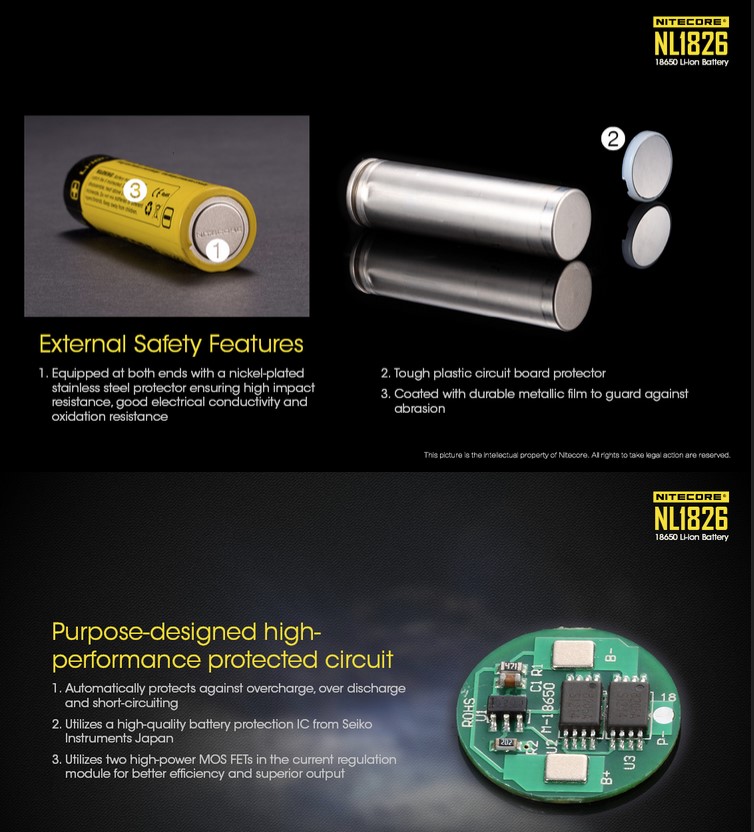
I have some protected Nitecore NL1826 (2600 mah) and after several months in storage one is reading dead - ie not reading any voltage at all. I've tried all the tricks that members have recommended but it's still dead. Out of curiosity I stripped the wrap to find that underneath is a Samsung ICR18650-26H. I read online that ICR means a protected cell but now that I stripped the wrap and what looks to me like the protection circuit, I suspect that what I have is a flat top unprotected cell. Do you have any comments?

I also have a few cells recovered from laptops. Six are Panasonics but the other six have no markings at all. How safe are these IRL? I try not to do anything silly but to be honest I don't really understand in what circumstances they could be dangerous. I don't want to take silly risks but on the other hand, I don't want to junk what seem like perfectly decent cells. I am using a decent Nitecore smart charger.
 
I use recovered cells quite a bit but I do use them in single cell configuration only in low drain devices. Usually when you recover cells you will find one or 2 two from the pack that have failed. Use your head though. If the cell is swollen, deformed, leaking or appears damaged in any way dispose of it. Measure the internal resistance and remaining capacity. If you suspect the cell is bad its better to be cautious and dispose of it than get hurt.
 
.

Nitecore NL1826 looks like it does have a protection circuit... You might could get it back to life unless fuse blew...


ICR stands for Lithium Cobalt Oxide

IMR and INR are newer and safer chemistries for high drain apps...

I use laptop pulls but the are usually low capacity and unprotected. No harm in using them, just watch that they don't get run down to too low of a voltage (2.5v or so)

Lights like a Zebralight specifically take unprotected batteries, preferably IMR or INR versions...

Nitecore 2.jpg
 
I read online that ICR means a protected cell
Not quite correct... it means ICR should only be used with Protection. Either as a Protected cell, or in a light whose Driver has Low Voltage Protection. Because ICR chemistry is most at risk of Venting With Fire, during charging, after being overdischarged.

During charging is when an internal short, caused by overdischarging an ICR (below 2.5V), is most likely to cause the battery to overheat and potentially "Vent with Fire"

ICR should only be used with Protection. The Protection can either be built onto the battery. Or it can be in the Driver of the light (such as a Zebralight).
I don't really understand in what circumstances they could be dangerous.
An UnProtected ICR is dangerous during charging, IF it was overdischarged. Overdischarge of an UnProtected ICR could happen if the battery is drained below 2.5V, by using it in a light that does not have Overdischarge Protection built into the Driver (such as Fenix and Nitecore 18650 lights)

Most older design lights that use Protected Batteries, dont have Protection built into the Driver. (again such as Fenix and Nitecore).

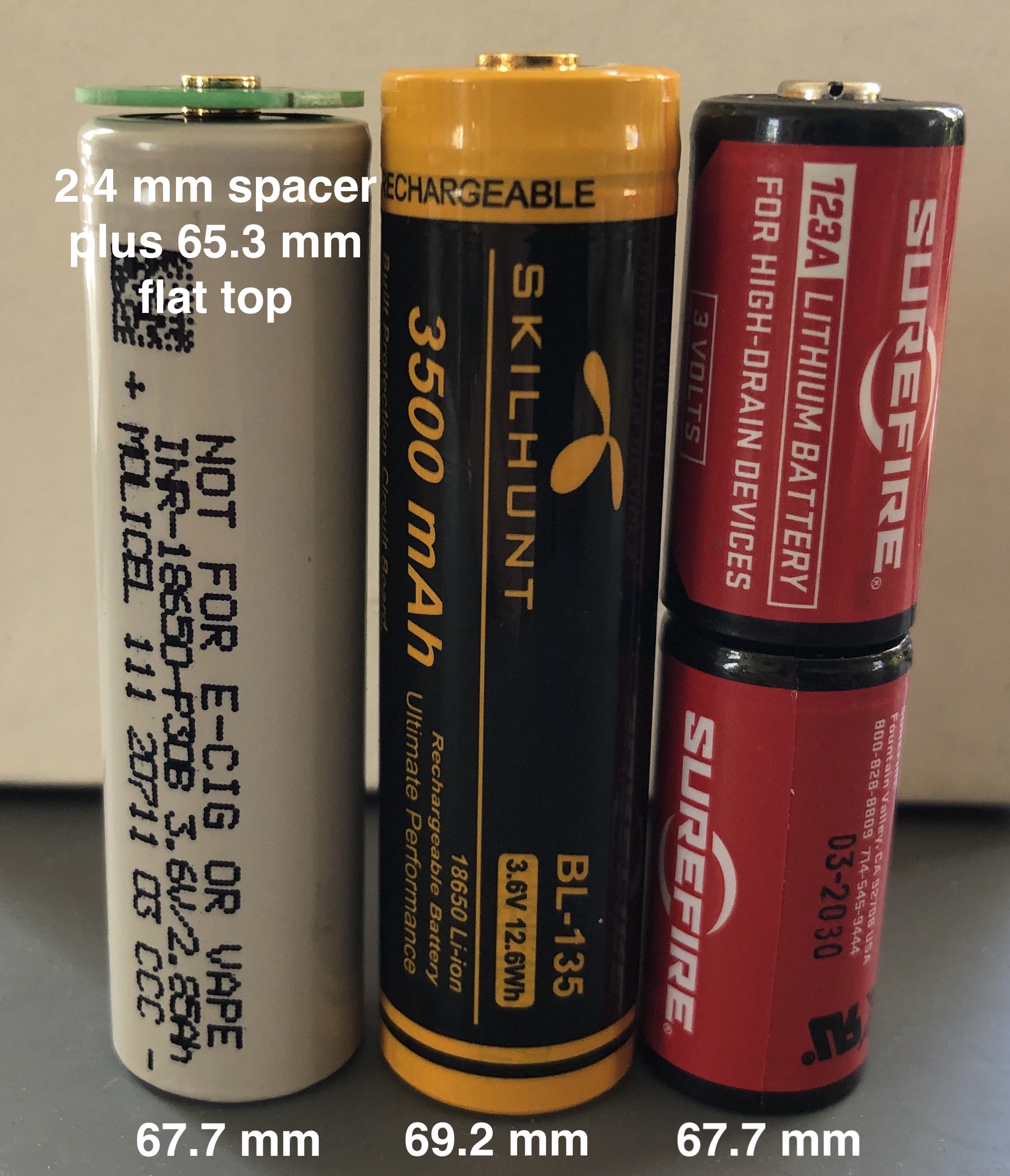
fwiw, the Protection Circuit on a battery is added on top of an UnProtected Flat top. Protected batteries are Always Button Tops.. Flat Tops are always UnProtected. (but some Button Tops are also UnProtected)...

In 18650 size, an UnProtected Flat top is typically 65.3 mm long. A Protected 18650 is typically 69.3 mm long.. iow the protection and button top, add 4mm to the length of the flat top.

It is a Bad Idea to use an UnProtected ICR in a Fenix that is designed to use Protected batteries, because there is no Protection in the Driver.

It is OK to use an UnProtected ICR in a Zebra, because the Driver has built in Protection.

Some lights that are built with a body tube long enough to fit a Protected 18650, wont make good contact with a shorter UnProtected Flat Top, such that bumping the tail of the light will cause the battery to lose contact and shut the light off.

Skilhunt uses longer body tubes, that fit Protected 18650, but the light also has Low Voltage Protection built into the driver. So Skilhunt can use either Protected or UnProtected batteries. The length issue still applies in the case of using UnProtected 18650 Flat tops in a Skilhunt, bumping the tail will cause the battery to disconnect. This can be remedied by adding a Button Top Adapter/Spacer, because the Driver has Protection. Do not use a Button Top Adapter/Spacer in a Fenix, that lacks Protection in the driver.
jPMRU1E.jpg


Some lights that are built to use UnProtected Flat Tops, have a body tube that is too short to fit a Protected Button Top. (For example Zebra SC64, which has Low Voltage Protection built into the driver.)

Therefore, the decision to use an UnProtected battery, hinges on using it in a light that has built in protection in the Driver (such as Zebralight).

18650 Protected batteries are always Longer than the UnProtected versions..

In 16340 there is variation, some Protected 16340 are Not longer than UnProtected (and they are Button Tops), but some Protected 16340 Button Tops are longer than UnProtected Button Tops.

In 18350, Protected are longer than Unprotected (and the Unprotected cells are Flat Tops)

In 14500 we find Protected Button Top cells that are the same length as Unprotected Button Tops. However, even in 14500, Flat Tops are always UnProtected, and they are shorter than Button Tops.

disclaim, not an expert, this is all just true to the best of my present knowledge
 
Last edited:
Hi All. Could I have some advice about 18650's.

I have some protected Nitecore NL1826 (2600 mah) and after several months in storage one is reading dead - ie not reading any voltage at all. I've tried all the tricks that members have recommended but it's still dead. Out of curiosity I stripped the wrap to find that underneath is a Samsung ICR18650-26H. I read online that ICR means a protected cell but now that I stripped the wrap and what looks to me like the protection circuit, I suspect that what I have is a flat top unprotected cell. Do you have any comments?

I also have a few cells recovered from laptops. Six are Panasonics but the other six have no markings at all. How safe are these IRL? I try not to do anything silly but to be honest I don't really understand in what circumstances they could be dangerous. I don't want to take silly risks but on the other hand, I don't want to junk what seem like perfectly decent cells. I am using a decent Nitecore smart charger.

As already pointed out by @Lips , the NL1826 is a 'protected cell'.

'Same as it ever was'

Have you tried this, from a previous thread of yours?

In the case of separate cylindrical cells like ours, if one's charger does not provide this function, they may be reset by briefly (single-digit seconds) applying a voltage (in parallel) to their terminals directly. That's often accomplished by simply connecting a normal / charged cell directly in parallel with the one that's tripped (+to+, -to-). I don't need to do this, but I'd just rubber band them together and press the buttons down on a conductive surface, then briefly connect the 2 (-) terminals together w/ something conductive (wire/paper clip/tool, etc.)
"Briefly" above means ~3-5 sec.
If a cell cannot be reset in this way it should be taken out of service, and should NOT be disassembled.

I just reset a cell this way about a week ago. It was a protected Nitecore 16340, but the same technique should work, if it is actually a 'tripped' over-discharge / under-voltage protection circuit. If that doesn't work, my recommendation remains as above.
 
Last edited:
@Toulouse42

I just noted that, previous instances aside, in the current instance an otherwise believed-good and normally charged cell was found, in a 'zero volt' state, after only several months of storage. I've never actually experienced that with any lithium ion cell that I can recall. All of mine seem to retain significant open-circuit output voltage level even after several years, not months, so that would make me suspicious. I might be concerned that some sort of internal high-resistance shorting might be able to drain one down this way, and if that were the case, I might choose to retire that one, as-is.

I know little about the internal electro-chemical aspect of cells, but I seem to recall some who know more than I do discuss such a failure mode before, and if so, I don't think it ended well.

EDIT: I supposed that an internal failure of the protection circuit could also cause such a condition, but if that were to be the case, that would not change the verdict on the cell, as it would still call for retirement, in my opinion.

Cheers!
 
Last edited:
Thank you all. This has happened before with these Nitecore cells. I store them carefully over the summer months (say seven/eight months) and when I get them out to prepare for the winter, one cell is stone cold dead. I have never been successful at "jump starting" one. To be fair, they are close to 10 years old but have not had a large number of recharge cycles.

I will accept it for what it is and have ordered some new ones - Some Nitecore and some Xtar.

From now on I think I will check them all more frequently in the hope of catching them before they're dead.
 
I typically check every cell I have every 3-6 months (i.e. 2-4 times a year), just to make sure. For cells stored in a flashlight, I un-screw the tail a quarter turn to prevent parasitic drain (also a handy habit to prevent accidental activation).

If you are looking for some 18650 recommendations, I can vouch for the Nitecore NL1836HP.

It's a pretty overpowered cell for most - if not all - retail flashlights, and comes with a premium price, but I personally find comfort in that.

Keeppower is also a good alternative. I haven't had any issues with any of my Keeppower cells.

It is a Bad Idea to use an UnProtected ICR in a Fenix that is designed to use Protected batteries, because there is no Protection in the Driver.

It is OK to use an UnProtected ICR in a Zebra, because the Driver has built in Protection.

Some lights that are built with a body tube long enough to fit a Protected 18650, wont make good contact with a shorter UnProtected Flat Top, such that bumping the tail of the light will cause the battery to lose contact and shut the light off.

Some lights that are built to use UnProtected Flat Tops, have a body tube that is too short to fit a Protected Button Top. (For example Zebra SC64, which has Low Voltage Protection built into the driver.)

Therefore, the decision to use an UnProtected battery, hinges on using it in a light that has built in protection in the Driver (such as Zebralight).
Can't speak to Zebralight, as that is not a brand available locally, but is there any way to determine whether a flashlight has built-in protection? I have always assumed "brand" flashlights (Nitecore, Fenix etc.) all have a protection curcuit built into the light, making a protected cell redundant.

That said, all of my Fenix lights have come with a cell included, and I have always used that. Exception being when I have upgraded the cell to a higher capacity one from the same brand, so all of my Fenix lights have a protected Fenix-branded cell in them.

Generally speaking, I have assumed lights with a spring in both ends supports both protected and unprotected cells, but preferring flat-top cells. And lights with only a spring at the bottom prefer button-tops. But none of that suggests, at least not to me, anything regarding protected or unprotected cells.

But to not take any chances, I always use a protected cell in the lights I know can potentially get banged up the most. I did once accidentally drop one of my Fenix lights onto concrete, and during inspection, I unscrewed the tail cap... and not only discovering I for some reason had used an unprotected cell in the light (I have no idea when or why I had done that - probably to get a larger capacity cell), but the cell was making an audible hissing sound.

I removed the cell and got it outside immediately. Nothing happened, and the cell eventually stopped hissing, but I ultimately discarded it. Though I was probably playing with fire when I kept the cell in the light (but disconnected) and tried charging it for a few minutes when I got home from work, just to check it, until my brain finally caught up with the situation and yelled "Hello! Wake up, stupid!". And I promptly carried the cell back outside, and left it there until I disposed of it.

The light didn't seem to care about being dropped a meter onto concrete, and still worked 100 % with a new battery. And still works 100 % to this day (Fenix PD35, 2014 model).
 
I recommend you just buy new non-protected 18650s from one of the well known online warehouses, like Battery Warehouse. Most are under $5 with many around $3.

The very best OEM (not rebranded) manufacturers are:

Panasonic
Samsung SDI
LG (LG Energy Solution / LG Chem)
Molicel (E-One Moli Energy)
Sony / Murata
 
is there any way to determine whether a flashlight has built-in protection?
I know from reading reviews by zeroair or 1lumen, for the specific lights.

Or you could ask the manufacturer. Or some manufacturers will disclose if their light has built in Low Voltage Shut off. If they dont have protection, the manufacturer usually does not mention that, but you can get a hint if they sell the lights with Protected Batteries, that the light itself is not protected.

Since Fenix and Nitecore come with Protected batteries, that suggests the Drivers do NOT have built in protection and it would be a Bad Idea to use UnProtected in those brands. Unless you make sure to use your brain as the Low Voltage Protection, and make sure not to overdischarge.. (this will not work if you fall asleep w the light on, or lend it to someone who leaves it on)

I always use a protected cell in the lights I know can potentially get banged up the most.
if they fit, that is a good idea, and there is no harm in doing that...

If the light works with 18650 Protected Cells, which are 4mm longer than UnProtected Flat Tops, it means the body tube must be long enough and that you Should use Protected Cells with that light.

Handheld 18650 Zebras such as SC65 only fit Unprotected Flat Tops.. the body tube is too short for Protected cells. The Zebra web page: specifically says:

"Warning: This flashlght takes flat top unprotected 18650s only. Any other types of batteries may damage the battery contacts inside and void the warranty."

The Zebra driver has built in Protection, and they mention that specifically:

"Builtin battery protections with continuously monitored temperature, current, and voltage, plus a (2.7V) low voltage cutoff"

I think you can buy Zebralights on their Aliexpress Store... but since you seem happy with Fenix and Nitecore, just keep buying their protected batteries for their lights.
 
Last edited:
Almost all Fenix lights have built in protection.
My PD-25 and a couple of others protect me by warning me, but will insist on shutting down if I ignore them long enough. They initially step down one output level, until they run out of lower levels, then they will do several(?) brief 'off-on' transtions to really get my attention, and as their last resort before overdischarging the cell and tripping its protection circuit, they then shut down.

I personally consider this optimal.

Low-voltage Warning Function

When the voltage level drops below the preset level, the PD25 is programmed to downshift to a lower brightness level. When this happens in Low output mode, the flashlight blinks three times every five minutes to remind you to replace the battery. Note: The function only works when the light is powered by 16340 rechargeable Li-ion battery. If the voltage of the 16340 battery drops below 3V, this function will be invalid when the light is turned off and then on again
 
Last edited:
thanks, seems to depend on the model

this one No LVP

this one No LVP

this one Yes LVP
Very interesting. I have a Fenix PD35 TAC ,which states in the manual that it has "Low voltage warning function" but then goes on to say that "Quality batteries with circuit protection will reduce the potential for combustion or explosion". So it looks like there's protection and there's "protection". Whilst I doubt that I personally would have a problem, I would not want to lend my flashlight to a loved one who would not understand the intricacies between protected and unprotected. On balance I think I'll just stick with protected cells. I'll store the unprotected cells for the moment.
 
I recommend you just buy new non-protected 18650s from one of the well known online warehouses, like Battery Warehouse. Most are under $5 with many around $3.

The very best OEM (not rebranded) manufacturers are:

Panasonic
Samsung SDI
LG (LG Energy Solution / LG Chem)
Molicel (E-One Moli Energy)
Sony / Murata
To me, there is only one unprotected 18650: the Molicel M35A. Molicel P50B for 21700.
The name also carries a meme weight with me, and I consider the M35A to be the spiritual predecessor of the M41A. Because they both pack a punch.
 
Does this mean that you can actively/inadvertantly bypass the LVP because the light will mistake a 3V LiIon as a primary?
Yes, but, only with an UnProtected battery, such as a Vapcel T8.

The stock Fenix USB 16340 battery is Protected. So it will prevent overdischarge.
 

Latest posts

Back
Top