


You are using an out of date browser. It may not display this or other websites correctly.
You should upgrade or use an alternative browser.
You should upgrade or use an alternative browser.
Great AA info
- Thread starter Beamhead
- Start date


- Joined
- May 15, 2012
- Messages
- 1,877
Good info, well-presented.
For the most part, no big surprises: Eneloops are your best bet all around; Lithium primaries are good if you need cold-temp use or long storage but otherwise too expensive; alkalines are terrible but Duracells are the best of a bad bunch.
However, I was interested to hear about a new class of Li-Ions that are bucked down to 1.5v for compatibility. They are all a bit quirky on charging right now, and I am not tempted because I like to stay well behind the bleeding edge on technology. But as the man says, this product class is probably going to grow in the years to come, so stay tuned.
There's a lot more in the video than I have summarized, especially about how to find the best bargains in dollar per runtime, so give it a look.
For the most part, no big surprises: Eneloops are your best bet all around; Lithium primaries are good if you need cold-temp use or long storage but otherwise too expensive; alkalines are terrible but Duracells are the best of a bad bunch.
However, I was interested to hear about a new class of Li-Ions that are bucked down to 1.5v for compatibility. They are all a bit quirky on charging right now, and I am not tempted because I like to stay well behind the bleeding edge on technology. But as the man says, this product class is probably going to grow in the years to come, so stay tuned.
There's a lot more in the video than I have summarized, especially about how to find the best bargains in dollar per runtime, so give it a look.
Last edited:

- Joined
- Nov 22, 2011
- Messages
- 7,471
- City & State/Province
- On the east coast of the yoosah. In the place wher
@Lumencraft (Matt) any plans on reviewing the Xtar lineup of bucked Li Ion cells? They have ones that exceed 4000mWh
Toulouse42
Enlightened
Excellent job, thanks.

Thanks for posting dah vid! ... (y)

Lumencraft (Matt)
Flashlight Enthusiast
As more of this type of cell emerges additional rounds of testing will be prudent. I will let Ethan know about The Xtar cell. He did all the leg work on this project. My only contribution was buying the batteries and test equipment.@Lumencraft (Matt) any plans on reviewing the Xtar lineup of bucked Li Ion cells? They have ones that exceed 4000mWh
For anyone interested in just the raw data we have a spreadsheet available with all the currently tested cells. https://bit.ly/AA_Battery_Comparison
I second that Beamhead.Thanks for posting dah vid! ... (y)


As an Amazon Associate we earn from qualifying purchases. Product prices and availability are accurate as of the date/time indicated and are subject to change.
Schokokeks
Flashlight Enthusiast
I just watched this when I saw it from your other video you'd posted.As more of this type of cell emerges additional rounds of testing will be prudent. I will let Ethan know about The Xtar cell. He did all the leg work on this project. My only contribution was buying the batteries and test equipment.
For anyone interested in just the raw data we have a spreadsheet available with all the currently tested cells. https://bit.ly/AA_Battery_Comparison
I second that Beamhead.
Great work, but maybe worth investigating with the Li-ion cells is that they put out a lot of radio interference due to the circuitry. I'm not sure if that will matter for flashlights, but for people looking for an all-around replacement, that might be a deal breaker (for instance, you can't really use them in an emergency radio).
Also, I am going to just add a keyword phrase for future searches because the title of this thread doesn't really reflect what's in here (in any way that would be found with a search of the video):
Lumencraft "Testing every battery to find the winner" YouTube video.
Great work, but maybe worth investigating with the Li-ion cells is that they put out a lot of radio interference due to the circuitry. I'm not sure if that will matter for flashlights, but for people looking for an all-around replacement, that might be a deal breaker (for instance, you can't really use them in an emergency radio).
On that subject, here's some stuff to keep in mind.
One word y'all: NOISE. It's the elephant in the room that few want to address. It's a word that will make any experienced electronics professional cringe - especially me.
Here's a quote from a 'review' of some Xtars:
EDIT: I neglected to include acknowlegment of and thanx to 'sammyshp' for this quote:
************************************************************************************
"Another device I used for testing is a radio clock with external temperature sensors. At about 1.3V the display starts to fade, at 1.2V it is almost unreadable. And that's the normal...
Here's a quote from a 'review' of some Xtars:
EDIT: I neglected to include acknowlegment of and thanx to 'sammyshp' for this quote:
************************************************************************************
"Another device I used for testing is a radio clock with external temperature sensors. At about 1.3V the display starts to fade, at 1.2V it is almost unreadable. And that's the normal...

Keep in mind that the RFI issues are both 'conducted' and 'radiated', and are not simply limited to affecting devices which use RF to communicate (as with the example above involving a 'radio-clock with external temperature sensors', but also digital devices which do not involve any external RF communication functions at all, (such as with the self-contained 'clock-thermometer' in the other example). Also, 'RF' isn't just about 'radios', but also A/V RF remotes, Bluetooth, Wi-fi, cellular, etc. In the digital realm, if the SNR (signal to noise ratio) gets too bad, it becomes more and more difficult to tell a one from a zero, and bit error rates go up (which you may or not be aware of / notice). If it gets bad enough, things shut down. Somewhere in between those 2 things one can go from being unaware of the problems / degraded operation, to going crazy trying to figure out the cause of the failure(s). It can be a nightmare scenario for the user or technician.
Xtar does document the issue with "radios", but without mention of other digital devices, and $100 says even this probably doesn't appear on the product packaging:
"...They are also not suitable for radios due to the noise caused by electromagnetic interference."
I also doubt it is possible to design a cell operating on these principles which does not have these issues, and would currently assume that all similar devices on the market suffer from the same deficiency, and apparently Xtar agrees with both those statements.:
"Can the electromagnetic wave interference be solved?
Not yet resolved. Because the rechargeable 1.5V lithium battery has a built-in charging/discharging and voltage step-down circuit. It will cause electromagnetic effect from the inductance in the circuit. All the 1.5V lithium batteries on the market have such characteristic."Both of those XTAR quotes are found here:

FAQs about XTAR 4150mWh AA Li-ion Battery - XTAR
The frequent questions and answers to the XTAR 4150mWh AA Li-ion battery. Is it safe, which devices is it suitable for, etc.
www.xtar.cc
Further, in theory: Also keep in mind that while these cells produce a potential interference 'signal' at a specific frequency, their output waveform is a square wave, as seen in the time domain with an oscilloscope. A square wave is essentially the sum of a single sine wave signal at a specific 'fundamental' frequency, plus all of the odd harmonics (3,5,7...) of that frequency, and when viewed in the frequency domain with a spectrum analyzer, those signals would be displayed as secondary signals appearing at frequencies which are odd multiples of the fundamental frequency, albeit at decreasing amplitude as they get further from that fundamental frequency. So rather than a single offending frequency, this results in a number of potentially interfering signals across a range of the spectrum. Simplified, that looks something like this:
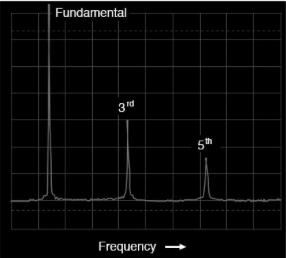
I don't currently have access to either a scope or a spec-A, so I can't do measurements of these signals on samples, or do the type of testing that's called for with these cells, and apparently most of those doing cell testing know very little of such things.
In my opinion / speculation: These things should be subject to a requirement for FCC certification under FCC CFR Title 47, Part 15C, which applies to 'Unintentional Radiators'). The problem is that these are not just 'cells', but are switching power supplies with an internal power source. Most lithium battery assemblies are tested as part of the cert testing of the equipment they are used / installed in, and these separate, standalone cells have never existed until now(?), and thus they likely fall through a giant loophole that allows them to be sold as a standalone product without FCC certification. I'm not an attorney who works with FCC regs., so I'm just speculating about what has created this problem / allowed it to exist. Clearly these things should be subject to testing / FCC certification IMO. Currently, it appears to me they fall into a loophole which should be closed, as some are taking advantage of this. I might call it 'clever', but that would be far too kind;-)
I'm not going to carry on and bore people to tears, but if you have a question about anything in this post or the one I linked to, let me know and I'll try to clarify.
cc: @DaveTheDude (I owe him some info;-)
Schokokeks
Flashlight Enthusiast
Excellent comment.
I'd first come across these types of cells via ham radio nerds (I don't do ham radio, but I casually poke around), and they were talking about the interference issue.
I hadn't thought about it, but you're right about the additional noise they'll create.
Color me unsurprised that the FCC wouldn't have done anything. When I'm wearing my tin foil hat, I sometimes think some of the "new, innovative" products come out of China because it's easier to move them into the market without regulators noticing them.
All-in-all, I'm still a die hard Eneloop guy, haha. It was interesting to see that lithium primary didn't do as well a NiMH in the higher drain device, too, in regards to maintaining voltage.
I'd first come across these types of cells via ham radio nerds (I don't do ham radio, but I casually poke around), and they were talking about the interference issue.
I hadn't thought about it, but you're right about the additional noise they'll create.
Color me unsurprised that the FCC wouldn't have done anything. When I'm wearing my tin foil hat, I sometimes think some of the "new, innovative" products come out of China because it's easier to move them into the market without regulators noticing them.
All-in-all, I'm still a die hard Eneloop guy, haha. It was interesting to see that lithium primary didn't do as well a NiMH in the higher drain device, too, in regards to maintaining voltage.

alpg88
Flashaholic
- Joined
- Apr 19, 2005
- Messages
- 6,254
You can't be sure if the cells internal converter will affect a radio unless you actually try. I use green AAA from xtar in a walkie talkie, it seem to have no issues, same with blue AA, which I tried in old sony am/fm/sw radio, but it does not mean other radios will not get affected. Try it first , you never know.
As far as harmonics, rf noise in these cells is so tiny, it is not the situation where you bring up harmonics.
As far as harmonics, rf noise in these cells is so tiny, it is not the situation where you bring up harmonics.


