Lithium AA Primaries in Freezer?

Candle Power Forums

Help Support Candle Power:

sosunny

Newly Enlightened
Joined
Mar 31, 2009
Messages
3
Since storing NiMH cells in the frigde/freezer makes them store the energy longer, what about Lithium AA Primaries?

I have some Energizer e2 Lithium Primaries that i was thinking of putting in the freezer.

Would that harm the cells, or would storing them in a cool dry place be sufficient?
 
Store batteries in the *refrigerator*, not the freezer.

My father worked at a pro camera store for many years, they would place storage/unstocked film and batteries in a basic home refrigerator in the back room. So if you buy your batteries from a professional enough business, they've already been stored in a fridge..

Get yourself a Ziploc bag/Tupperware container, fill it with your batteries, and store it in a bottom drawer in your fridge, it does indeed help reduce self-discharge.
 
Hmmmm, any chance of condensation in the storage container?

Lithium + water = :poof:
 
I get a flashlight out of my mailbox (oh goodie - gifts!) - and keep in mind it's winter...take it in the house & condensation forms on it when I bring it into the house due to the temp difference. I don't put any cells in it until it's all warmed up & no moisture present.

I put <insert favorite item> in a ziploc bag, then into the fridge (storing it for awhile)...take it out...typically there's some condensation just from the temp difference.

Maybe I didn't watch enough Mr. Wizard when I was younger? :thinking:
 
Last edited:
A little condensation won't hurt batteries since they are sealed. Suck the air out of ziplock bags before place in fridge will help as well.
 
As an Amazon Associate we earn from qualifying purchases. Product prices and availability are accurate as of the date/time indicated and are subject to change.
Store batteries in the *refrigerator*, not the freezer.

My father worked at a pro camera store for many years, they would place storage/unstocked film and batteries in a basic home refrigerator in the back room. So if you buy your batteries from a professional enough business, they've already been stored in a fridge..

Get yourself a Ziploc bag/Tupperware container, fill it with your batteries, and store it in a bottom drawer in your fridge, it does indeed help reduce self-discharge.

Why "fridge", and not "freezer"?
I've read many articles and threads on it, and there's been alot of debate on which is better or worse.

And still I cannot come up to an answer of which is the better one.
I know it also depends on the temp of the frigde/freezer.

I understand that fridge is technically a "cool dry place", but then the fridge is colder, and people have said that storing NiMH cells in the freezer lasts way longer than fridge.

So Primary AA Lithium's would gain storage life in the fridge/freeezer?
 
I find no reason to store any of my cells in the freezer and have had great results storing them in a sealed container in the fridge. My Lithium primaries were stored in a new state in the fridge for over a year. They showed 100% capacity when I took them out and tested them.

Same with NiMH, lower self-discharge rate when stored in the fridge.
 
Why "fridge", and not "freezer"?
I've read many articles and threads on it, and there's been alot of debate on which is better or worse.

And still I cannot come up to an answer of which is the better one.
I know it also depends on the temp of the frigde/freezer.

I understand that fridge is technically a "cool dry place", but then the fridge is colder, and people have said that storing NiMH cells in the freezer lasts way longer than fridge.

So Primary AA Lithium's would gain storage life in the fridge/freeezer?

Because storing them in the freezer would cause an explosion of such massive proportion, it would kill everyone within a 3 mile radius, much comparable to a nuclear explosion.

In fact, it's rumored that the US govt. is actually looking to switch to Energizer Lithium AA's instead of nuclear bombs. The theory being that an Lithium AA taped to a small vial of liquid nitrogen would break on impact with the ground after being dropped from a plane -- causing the AA to freeze on impact and explode, thus killing enemies for miles. :poof:
 
Why "fridge", and not "freezer"?

The freezer is simply too cold - most battery types are rated to -20F, but will begin getting iffy/unreliable around 0F, and most freezers have many areas that are 0F or below. Li-Ions can also be permanently damaged by temps as modest as 0F. The refrigerator's ~40F is guaranteed not to harm your batteries but will minimize self-discharge.

Because storing them in the freezer would cause an explosion of such massive proportion, it would kill everyone within a 3 mile radius, much comparable to a nuclear explosion.

I think that's only if you drop them into a two-liter of Diet Coke, or something..
SmileyBomb.gif
 
The freezer is simply too cold - most battery types are rated to -20F, but will begin getting iffy/unreliable around 0F, and most freezers have many areas that are 0F or below. Li-Ions can also be permanently damaged by temps as modest as 0F. The refrigerator's ~40F is guaranteed not to harm your batteries but will minimize self-discharge.

So Lithium AA Primaries would be bad in freezer eh?

I'm assuming the same thing goes for NiMH cells?
I've read stories about people having 10 year old cells in the freezer and they still have about 90% charge.
 
Likely there are limited issues storing your batteries in the freezer. Just do not pull them out and use them right away. Allow them to come up to temperature first. Designed storage temperature for things like batteries is very wide to handle all shipping conditions. One should not confuse shipping and storage with usage.

Lithium primaries will have an operational range extending down -40C, though generally they are not recommended below -20C as they lose a lot of capacity and they internal resistance goes up. That applies to both CR123 as well as AA types such as the Energizer Lithium AAs.

Lithium ion storage only goes down to -20C (-4F). Odds are your freezer gets into that range, but probably not below it or at least not much. NiMh are rated for the same -20C.

Lithium primaries have very low self discharge even at room temperature due in part to their lower operating voltage compared to lithium-ions. Putting them in the fridge/freezer will be even better, but not sure how long you plan to keep them. Energized Lithium AA are rated 15 years, 90% capacity at 21C. CR123 types are not quite that good, but still very high.

Semiman
 
Last edited:
Just read this today...

http://www.mpoweruk.com/storage.htm says
Lithium-Ion
The possible storage temperature range for Lithium-Ion batteries is is -20°C to 60°C but for prolonged storage period -20°C to 25°C is recommended and 15°C is ideal. Cells should be stored with a partial charge of between 30% and 50%. Although the cells can be stored fully discharged the cell voltage should not drop below 2.0 Volts per cell and cells should be topped up to prevent over-discharge. The maximum voltage should not exceed 4.1 Volts

edit:
oh -- I see now you said primary. from the same source:
Primary Cells

Storage conditions are particularly important for primary cells because they can not be recharged and any capacity loss is therefore permanent. While it is always recommended to keep cells cool during storage, keeping them refrigerated is even better. A temperature range of 0°C to 10°C is preferable to avoid freezing of the aqueous electrolyte. For prolonged storage the cells should be stored in vapour proof packing should help to alleviate the problem of electrolyte loss.

.... but does lithium primaries have aqueous electrolyte in them -- I shouldn't think so. Still 15C is ideal, it says.​
 
Last edited:
Lithium-Ion
the cell voltage should not drop below 2.0 Volts per cell

Yikes, that should be 3.6 volts per cell, anything lower than that is damaging the cell regardless of temperature :duck:

Primary Cells
A temperature range of 0°C to 10°C is preferable


0°C to 10°C = 32°F to 50°F, making the refrigerator's 40°F average just right.
 
http://www.mpoweruk.com/lithiumS.htm says 2V too -- I wonder where they are getting figure from.

http://en.wikipedia.org/wiki/Lithium_ion_battery says
Li-ion batteries should never be depleted to below their minimum voltage, 2.4 V to 3.0 V per cell.

http://batteryuniversity.com/parttwo-34.htm says
Some lithium-ion batteries fail due to excessive low discharge. If discharged below 2.5 volts per cell, the internal safety circuit opens and the battery appears dead. A charge with the original charger is no longer possible. Some battery analyzers (Cadex) feature a boost function that reactivates the protection circuit of a failed battery and enables a recharge. However, if the cell voltage has fallen below 1.5V/cell and has remained in that state for a few months, a recharge should be avoided because of safety concerns. To prevent failure, never store the battery fully discharged. Apply some charge before storage, and then charge fully before use.

http://www.buchmann.ca/article28-page1.asp says
To prevent the battery from over-discharging, the control circuit cuts off the current path at about 2.50V/cell.

But http://www.mpoweruk.com/life.htm says
By restricting the possible DOD [depth of discharge] in the application, the designer can dramatically improve the cycle life of the product. Similarly the user can get a much longer life out of the battery by using cells with a capacity slightly more than required or by topping the battery up before it becomes completely discharged.

This last doesn't seem to refer specifically to lithium, but http://www.mpoweruk.com/lithium_failures.htm also says a 2 V minimum.
Under-voltage / Over-discharge
Rechargeable Lithium cells suffer from under-voltage as well as over-voltage. Allowing the cell voltage to fall below about 2 Volts by over-discharging or storage for extended periods results in progressive breakdown of the electrode materials.
Anodes
First the anode copper current collector is dissolved into the electrolyte. This increases the self discharge rate of the cell and can ultimately cause a short circuit between the electrodes.
Cathodes
Keeping the cells for prolonged periods at voltages below 2 Volts results in the gradual breakdown of the cathode over many cycles with the release of Oxygen by the Lithium Cobalt Oxide and Lithium Manganese Oxide cathodes and a consequent permanent capacity loss. With Lithium Iron Phosphate cells this can happen over a few cycles .

Where does the 3.6V figure originate? Is that an older or newer cell (meaning how long ago the cells associated with that number was made), or does it refer to older cell (meaning used more or aged more), and is the for the same chemistry as cells referred to above? WHICH li-ion chemistry? And is 2V a critical minimum while 3.6 is minimum for best practice and cell life?

But there seems to be something wrong with that 3.6 volts figure is http://www.ibt-power.com/Battery_packs/Li_Ion/Lithium_ion_tech.html is correct in that
Lithium Ion Cell Specification Nominal Voltage 3.7V

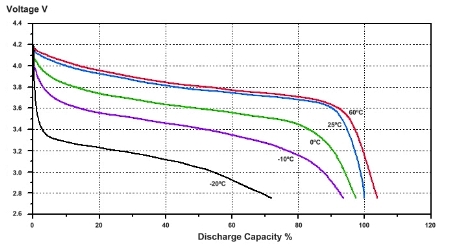
With the voltages in the graph:

Typical Discharge Graph
CC/CV Charge at 4.2V,1C, +25ºC. CC Discharge at 0.2C to 2.75V.
Li_Ion_DiscTGph.JPG


Did you recall that figure incorrectly, or is there another criteria here? It does look like with most of the discharge curves letting it go below 3.6V would lead to the ight soon going dim, and perhaps with a regulated light sucking too much juice from the battery.

But then http://www.batteryjunction.com/protected-14500-lithium.html

UltraFire Battery LC14500 3.6V

Capacity: 900mAh
Rechargeable for 600-800 times
Peak Voltage: 4.2V
Nominal/Working Voltage: 3.6V
Temparature: -40C~60C
Dimension: 14x52mm
Protected against short circuit, over discharge, over-current discharge.

It looks to me like your 3.6V figure is mistaken, as far as damaging the cell.
 
It looks to me like your 3.6V figure is mistaken, as far as damaging the cell.

Li-Ion cells seem to be a little different. They seem to be easily damaged at higher or lower than "normal" voltages. The damage is compounded by the amount of time spent outside the normal range, but over voltage incurs almost immediate damage, and under voltage, while it takes a little longer to occur, does end up damaging the cell.
if you are using bare li-ion cells... yank cell at first sign of dimming. immediately measure cell voltage for first few uses to establish if over discharge is occurring. for all practical purposes, cells is empty under 3.5V. your goal is to yank cell before it goes below 3.5V.

cells can recover if exposed briefly below 3V. damage can occur with ONE overdischarge. which will not show until you try to recharge cell.

This is way off topic though, you might want to start another thread if you want to continue it..
 
Hello Bluepilgrim,

Where does the 3.6V figure originate? Is that an older or newer cell (meaning how long ago the cells associated with that number was made), or does it refer to older cell (meaning used more or aged more), and is the for the same chemistry as cells referred to above? WHICH li-ion chemistry? And is 2V a critical minimum while 3.6 is minimum for best practice and cell life?

I believe the source of your confusion comes from how the voltage is measured...

The articles you referred to are talking about voltage under load. The 3.6 volt figure is open circuit voltage taken several minutes after the load has been removed.

This 3.6 volt value came from the RC people. The did a series of tests by setting the low voltage cut off devices they use to different levels. They are typically drawing high currents. Since each airplane and RC vehicle is set up a little differently, they set upon open circuit resting voltage as an indicator of over discharge.

This means that a cell could be run at a 2C current down to 2.5 volts, and if the voltage rebounds to 3.6 volts after a few minutes of resting, unloaded, it probably hasn't been over discharged to the point of damaging cycle life. On the other hand, the same cell discharged at a 0.1C rate down to 2.5 volts may only rebound to 2.7 volts after resting, and it has probably been damaged.

Also, keep in mind that in normal electronic use the protection circuit is a back up termination method. The devices circuit will usually signal low battery and shut down before the protection circuit cuts in. This means that the protection circuit is designed to avoid major damage to the cell, and not that it is good to use that voltage as a normal discharge cut off.

Tom
 
Back
Top